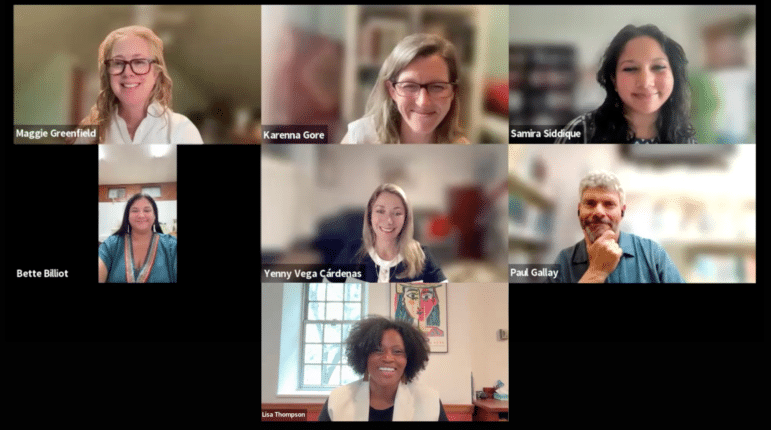
“Water is not a commodity. In some ways, it’s a covenant: it carries memories, it sustains life and it carries the sacred,” reflected Union Theological Seminary President Lisa Thompson while welcoming guests to a webinar on the status of clean water protection hosted by the Center for Earth Ethics on July 28, 2026.
Today, however, 80% of the country’s wetlands and millions of miles of creeks and streams are at risk of losing clean water protections due to a proposed federal redefinition of Waters of the United States (WOTUS). CEE’s April 2026 report, “Turning Tides: Policy, Ethics, and the Promise of Clean Water,” details this threat. The piece—authored by CEE consultant Maggie Greenfield, with CEE Executive Director Karenna Gore and Paul Gallay, a strategic advisor at CEE and director of the Columbia Climate School’s Resilient Coastal Communities Project —assessed the status of clean water protection efforts in the country since the passage of the Clean Water Act in 1972.
Greenfield framed the conversation with an overview of “Turning Tides,” emphasizing that while federal deregulation and a recent Supreme Court decision triggered the immediate crisis, [it] “is not only legal or scientific. It reflects a deeper philosophical struggle over how society views its relationship to the rest of nature.”
Billiot, a member of the United Houma Nation Tribe of Louisiana, reflected on how her community’s relationship with water has shaped her advocacy work. Because the freshwater swamps traditionally provided “everything we needed to survive and be sustained,” they demanded respect. “It is a relative to us,” she said, “When the waterways take care of us, we have a duty and a responsibility to take care of the waterways,” she explained.
Cárdenas echoed this sense of reciprocity and interconnectedness: “If we pollute water, we are polluting biodiversity, the ecosystem, and at the same time, we are affecting our own survival capacity—because we are part of the ecosystem.” These values are at the core of her work as a lawyer fighting for the legal personhood of the Magpie River in Canada. She emphasized the importance of blending traditional ecological knowledge and Western science, and argued that water protection should be depoliticized as everyone’s shared responsibility. Cárdenas underscored how the Rights of Nature movement provides a vital framework for protecting the environment alongside human rights, pointing to the powerful case of Colombia’s Atrato River gaining legal personhood.
Water is not a commodity. In some ways, it's a covenant: it carries memories, it sustains life and it carries the sacred.
Gallay analyzed the politicization of clean water advocacy, explaining that, in the U.S. today, “fewer people [are] doing more work with less resources to support, and more of a culture and a climate of hostility to regulation.” He noted, however, that community engagement combined with transparency can lead to accountability, pointing out that “the ultimate indicator of accountability is: Do you value something enough to invest in it?” This emphasis on values grounded the entire discussion.
Panelists identified emerging pressures on water systems, like the growth of artificial intelligence data centers and continued fossil fuel infrastructure buildout. Gallay observed that “Data centers are set to increase our demand for water by roughly 40 billion gallons by 2028, almost doubling the amount of water that we use for homes, businesses and industrial manufacturing operations.” This will exacerbate water scarcity concerns in the Midwest, where aquifers are already being over-pumped due to industrial agriculture.
The webinar drew on a new policy note authored by Maggie Greenfield, with Karenna Gore and Paul Gallay.
Panelists also pointed to solutions. Billiot emphasized the power of engaging youth while ensuring they remain connected to the wisdom of their elders. Working intergenerationally helps contextualize climate impacts, with older community members being able to reconnect the changing landscape to a separation from culture, identity and language.
Greenfield similarly highlighted efforts in the Bronx to provide local children with opportunities to connect with the Bronx River. “It gives everything such a different context when people feel really locally connected to their waterway or their bioregion,” she said.
Gore closed the conversation by acknowledging the recent 250th anniversary of the United States Declaration of Independence, framing the moment as an opportunity to renew collective efforts to protect water and to hold elected representatives to account.
To learn more, access a full recording of the webinar here, and read the Turning Tides report here.
Clara Chavez-Ives
Clara Chavez-Ives is a research and policy associate at Center for Earth Ethics.