Standing Where We Are
The Very Rev. Winnie Varghese on Earth, Justice, and the Imagination of Faith
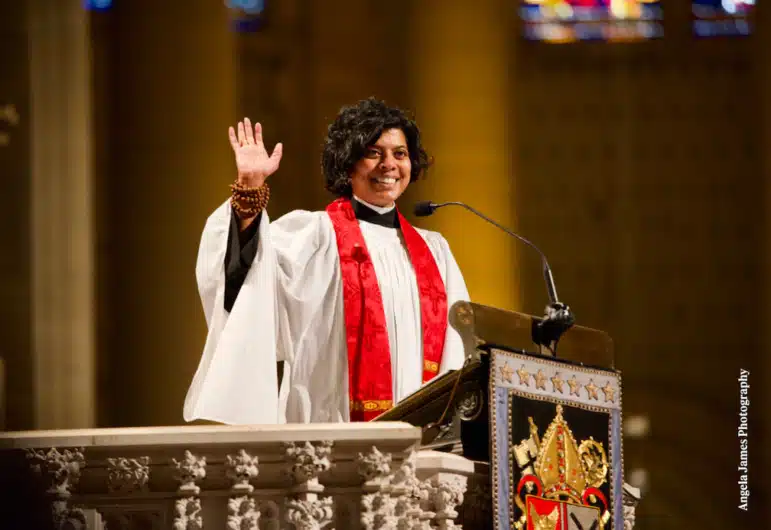
The Very Rev. Winnie Varghese is the 12th Dean of the Cathedral of St. John the Divine and the first woman and person of color to hold this position in the cathedral’s 133-year history. Born to Indian immigrants from Kerala and raised in Dallas, Varghese is a Union Theological Seminary graduate, a published author (“Church Meets World: Church’s Teachings For a Changed World“) and a widely recognized voice on justice, inclusion and the public life of faith.
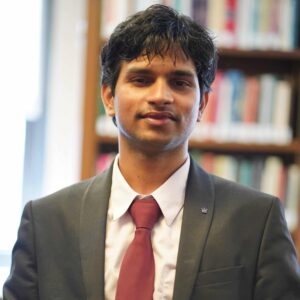
As a researcher and advocate with a background in philosophy from India, I approached this conversation from my own personal experience and on formation in climate justice and philosophical thought. I was attentive to who gets to speak, whose lives are made expendable and how faith communities might help reimagine our relationship with Earth and each other beyond extraction and disposability.
What follows is a hybrid of conversation and reflection: an attempt to sit with Varghese’s theology of land, social location and awe as a way of staying human in a burning world.
Earth Ethics in a Time of Crisis
When I asked Dean Varghese what “Earth Ethics” means in a time of climate crisis, she began with how long the warning signs have been in front of us. As a student in the 1980s and 1990s, she read scholarship from the 1970s that described the environmental breakdown now unfolding in plain sight. What once sounded radical, distant, or overly poetic has become difficult to deny.
“The crisis is upon us exactly as it was predicted,” she said.
For Varghese, Earth Ethics begins with facing that fact. But it cannot stop at acknowledgement. It asks faith communities to examine how they live, what they owe to one another, and how moral and spiritual traditions shape their relation to land, water, other species, and the people living with the worst effects of environmental damage.
As a priest, she turns to the chapter of Genesis as an imaginative account shaped by a people in exile. “There’s a reason that people of Israel in Babylon decide to tell a story that God creates everything,” she said. In her reading, the enduring presence of water and darkness matters most. They are already there, primordial and powerful, beyond human control.
That image cuts against the belief that human beings can manage or possess the Earth without a consequence. The planet is not a storehouse of resources, nor a stage set for human ambition. We are part of a living world whose limits and mysteries cannot be engineered away.
Earth Ethics, then, is about learning to live within limits—as creatures, not gods. It requires responsibility for the places we inhabit, attention to those made most vulnerable by environmental destruction, and enough humility to recognize that life is shared—and under threat.
Who are you fighting for if it is not, first, the people whose lives and futures are on the line?
David Sathuluri
Property, Land and the People Pushed Aside
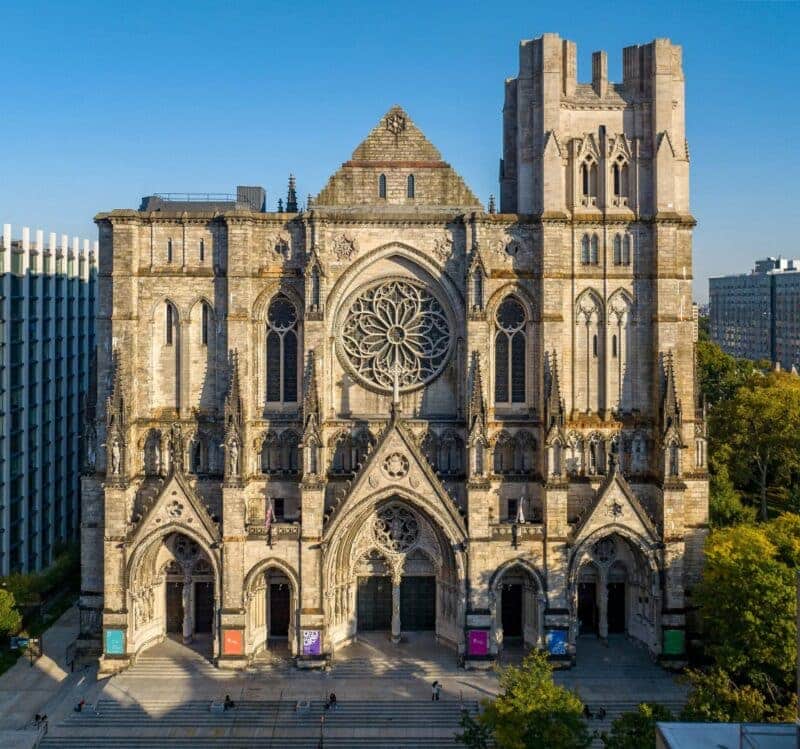
At the Center for Earth Ethics, we often talk about shifting from short-term gain to the long-term health of the whole community of life. I asked The Very Rev. Varghese what that shift looks like on the ground, in a cathedral that is both a spiritual home and a massive piece of urban infrastructure.
She starts with what might seem obvious but rarely gets named as theology: property.
“Churches have property,” she says. “We have property that’s not ours personally, but is our legacy… all over the world, our traditions have property. So what is our responsibility for this property?”
Questions that get framed as technical, retrofitting lighting, heating a 150-year-old building, deciding what to grow in a churchyard, are, for her, deeply theological. How we inhabit land, how we use inherited structures, how we account for the energy that keeps a sanctuary warm in winter: all of this belongs inside our ethical imagination, not outside it.
But she refuses to let the conversation stop at the edge of the church lawn.
“You can’t just take care of your square,” she says. Our “square” is entangled with everything around it: the city, the watershed, the communities already displaced in the name of preservation. In the United States, she points out, mainstream environmentalism has been deeply complicit in removing Indigenous peoples and poor communities from land to make way for parks and protected areas. There is a familiar pattern in which plants and animals are centered, while the people whose homelands are being managed are rendered voiceless.
Listening to her, I find myself thinking about India, where I come from about conservation and green energy projects that speak reverently of forests and wildlife while criminalizing Dalits, Adivasi (Tribals) and other marginalized communities whose lives are interwoven with those ecosystems. I told her that I often find myself asking, in those spaces: Who are you fighting for if it is not, first, the people whose lives and futures are on the line?
“There is no environmental or climate justice without social justice,” she agrees. Any Earth Ethic that leaves people, especially Indigenous communities, the poor, migrants, as collateral damage is not ethics at all.
Who Gets to Speak From the Land We Stand On?
Later, I ask how her own story, born to Keralite parents, raised in Texas, now leading an iconic cathedral in New York, what shapes the way she thinks about land, water, and belonging.
She describes an ache that will be familiar to many in the diaspora. For those of us who look a certain way and carry certain names, we are always being asked where we “really” come from. And yet, when we return to that supposed origin, we are marked as foreign there too.
In her twenties, she says, she knew how to express solidarity. What she did not know was whether she had permission to do anything else. Where, exactly, was she allowed to stand and speak from?
What shifted was paying attention to immigrants and undocumented people who had far less formal power than she did, but who still insisted on speaking from the ground under their feet. If they could claim that right, she realized, so could she.
“Maybe I can speak as a person who stands on this Earth right now,” she says.
She describes herself now as someone who stands in New York and yet feels free to say, “I am from Texas and I have strong feelings about who we are in Dallas. And I have strong feelings about who we are in central Kerala.” That multiplicity is a texture of her vocation.
There is no environmental or climate justice without social justice.
The Very Rev. Winnie Varghese
When I asked what she would say to younger people trying to resist climate breakdown and authoritarian politics from very different social locations, she answered carefully. She doesn’t offer an “answer,” but a response from her own life. That there is no accident in who you are, and no part of your story that does not belong in the work of liberation.
She names the parts many of us are taught to exile from our public selves like immigrant histories, disability, class shame, the body that feels wrong under someone else’s gaze. “There are always people around waiting for your cue,” she says. Your own liberation, your willingness to bring your whole self into the room, will be a key for them.
There is, in that claim, a quiet but devastating refusal of purity politics. The notion that we must sort out every tension and contradiction in our lives before we have the right to speak or act. For Rev. Varghese, our tangled, inarticulate parts are not a barrier to freedom.
Awe as a practice of resistance
Many people, especially younger people, tell me they feel numb about climate change, overwhelmed by the scale, unconvinced that their actions matter. I ask Rev. Varghese what spiritual practice she offers to people who feel that way.
She returns to a line from the baptismal liturgy: a prayer that we may have “awe and wonder in the works of God.”
For her, awe is not an escape from politics, but a way of staying in the work without burning out or hardening into cynicism. Justice work, she says, “never stops.” Victories are partial and provisional. Systems adapt and reassert themselves. Awe and wonder, the capacity to be moved by life beyond ourselves, become a way of keeping our hearts from closing.
Nature is not somewhere far away but it is right here, if we let ourselves notice it. A houseplant in a dorm room chapel. A tree on a city sidewalk. A patch of soil that invites hands into it. She talks about feeling, almost physically, the need to put her hands back into the Earth from time to time, to remember what she is part of.
Stand where you are. Speak from there. Let the full complexity of your life, the parts you don’t yet know how to name become part of the imagination we need to survive together on a damaged, beloved Mother Earth.
David Sathuluri
But, again, she refuses easy romanticism. She tells the story of a seminarian who grew up in Queens, who was afraid to touch the soil in a church garden because, in her experience, dirt meant broken glass, needles, danger. Even touching grass, now marketed as a kind of wellness intervention, is not equally available to everyone.
The implication is sharp. If awe and wonder are to be practices of resistance, then access to land, clean soil, and green space cannot remain a privilege.
Sitting with this conversation, I am struck by how insistently Rev. Varghese brings things back to where we actually stand: the land under our feet, the bodies we inhabit, the buildings we inherit, the stories that have formed us, the crises we can no longer pretend are far away. She does not ask us to be pure or perfect, but only to be honest to ourselves, about who we are, what we carry, and what we owe.
To those of us working in climate justice from the vantage points of justice, race and caste, ecology, spirituality or poverty, her invitation is both unsettling and deeply consoling. Stand where you are. Speak from there. Let the full complexity of your life, the parts you don’t yet know how to name become part of the imagination we need to survive together on a damaged, beloved Mother Earth.