We often encounter the climate crisis through numbers: rising temperatures, carbon emissions, melting ice and projections of a warming planet. These measurements are essential to understanding the scale of the crisis, but they can also make it difficult to feel our relationship to it. What does it mean to encounter the ecological crisis not only as data, but as something material, sensory and close to our everyday lives? Art offers one way of approaching this question by inviting us to slow down, pay attention and encounter familiar materials differently, thereby making visible the relationships that statistics alone may struggle to convey.
This summer, as part of my fellowship with the Tamer Institute for Social Enterprise and Climate Change, I worked alongside sculptor G. Roland Biermann, whose “Stations Five” was being installed in the outdoor sculpture garden at the Parsonage Gallery in Searsport, Maine. The fellowship supported my work as a research and engagement intern with the Center for Earth Ethics, exploring connections at the intersection of art, ecology and spirituality.
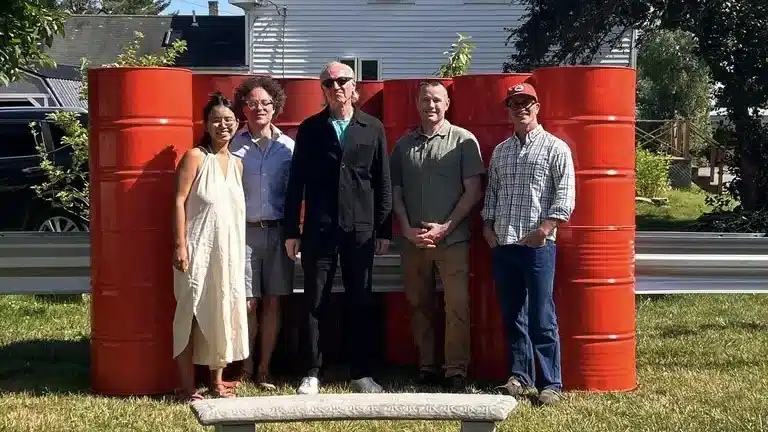
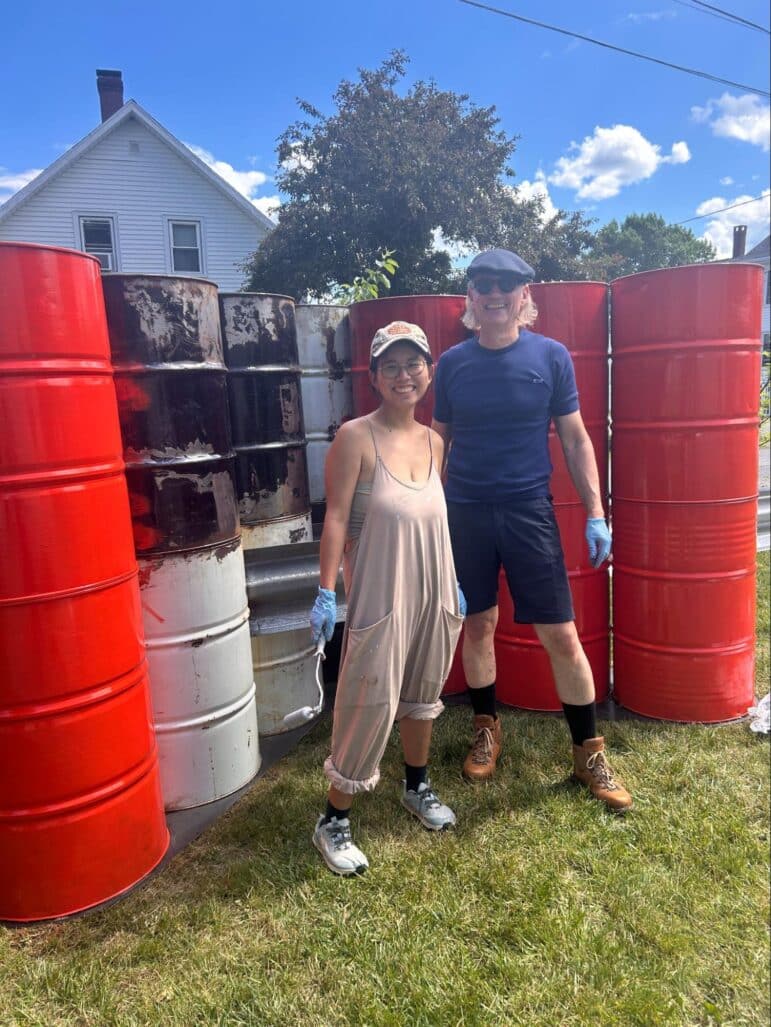
For almost a week, Biermann and I worked on the sculpture together. We painted oil barrels and highway guardrails, industrial objects that had already lived other lives before becoming part of his artwork. The guardrails had been discarded along a Maine highway after a car accident. The oil barrels, too, carried traces of a larger industrial world: oil extracted from deep beneath the Earth, loaded onto cargo ships, transported across oceans and highways and consumed to meet the energy demands of modern life.
Image 1 (Dr. Aaron Rosen): Biermann and the author working on “Stations Five”
Image 2 (Xiao Ma): “Please don’t get stuck!” Longhorn beetle on the oil barrel we were painting. Biermann laughed when I told him they are called 天牛 in Chinese, which means “sky cow.” We were worried about the beetle more than the oil barrel in this case.
Image 3 (Xiao Ma): Dr. Aaron Rosen, founder of the Parsonage Gallery, painting oil barrels
There was something strange and beautiful about spending days with these objects. Under the hot summer sun, we painted, sanded, cleaned, waited for things to dry and painted again. We were constantly making sure that the grass did not get onto the sculpture. Biermann was incredibly precise, which I admire. His artistic spirit shines through his vision. Every shade of red had to be just right; every surface needed to be evenly painted. We spent a surprising amount of time trying to make discarded industrial materials look almost impossibly perfect.
While we worked, we talked. I asked Biermann about the different shades of red, and he explained that they were connected to the Stations of the Cross (The Stations of the Cross is a Christian tradition consisting of fourteen stations that trace Jesus’s final journey to his crucifixion) and equally to blood being spilled in the pursuit of fossil fuels. Gradually changing from bright red to darker, rustier tones, they are the equivalent of blood’s drying process and the color change that accompanies it. In the large works from the Stations series of sculptures, each shade of red can be seen as an individual station. And on a more general level, they are simply a symbol for the passing of life. The oil barrels became bodies, blood, fossil fuels and the lives and landscapes entangled in our dependence on them.
The series is Biermann’s way of confronting the violence surrounding the pursuit of fossil fuels: the political struggles over extraction, armed conflicts, the environmental consequences of an oil-driven society, and the human costs embedded in the systems that can otherwise feel invisible. His use of the Stations of the Cross adds another layer of meaning to the work. A religious structure traditionally associated with suffering and sacrifice becomes a way of asking us to consider what and who, is sacrificed in the pursuit of energy.
By the end of our time working together, Biermann and I had become friends. I loved working together with him. His precision was very different from the way I often approach art. As a photographer, I am drawn to moments that cannot be completely controlled: changing light, movement, gesture, accident. Biermann showed me another kind of attentiveness, the patience of making something carefully, one surface at a time.
Image 4 (Xiao Ma): Biermann completing the last bits of touch-up
Image 5 (Xiao Ma): “Stations Five”
When we finished the sculpture, I interviewed him about the work. I was particularly interested in how the landscape itself became part of the sculpture. “Stations Five” was not simply placed outdoors; its form responded to its location. In Searsport, with its flat landscape and proximity to the waterfront, Biermann chose a more horizontal structure. The same series has taken very different forms in London and New York. And once the sculpture is installed, the artist is no longer completely in control of how it is seen. Snow, sunlight, grass, seasons and weather all become part of its life. Biermann told me that the work would look completely different, surrounded by snow, than it did that summer, surrounded by green grass and leafy trees. He’s excited to see what “Stations Five” will look like in winter.
What does it mean to encounter the ecological crisis not only as data, but as something material, sensory and close to our everyday lives? Art offers one way of approaching this question by inviting us to slow down, pay attention and encounter familiar materials differently, thereby making visible the relationships that statistics alone may struggle to convey.
I thought about this encounter again when I attended a Climate Week conversation in September at Columbia University’s Heyman Center for the Humanities featuring artist and cultural worker Ernst Logar and his interdisciplinary project, “Reflecting Oil.” Logar brought artists and petroleum scientists together to engage with crude oil not simply as an abstract resource but also as a physical substance. Their experiments explored oil through viscosity, color, texture, smell, photography, microscopy, bacteria, sound and sculpture. One experiment even developed an “olfactory crude oil wheel” to categorize the different smells of crude oil.
Screenshot from Ernst Logar’s talk at Columbia
A central theme for both Roland and Logar was the idea of encounter. During my week with Biermann, oil was not an abstraction. It was sitting in front of me in the form of barrels and guardrails. I touched it, painted it, sanded around it and watched it change in the landscape. Logar’s work pushed this encounter even further, asking what might happen if we approached oil through all of our senses and through radically different ways of knowing.
Looking back, I realize that this may be one of the things I value most about working at the intersection of art and Earth Ethics. Ecological awareness is not only about learning more facts about climate change. It is also about learning to see differently.
A guardrail can become a trace of an accident, an oil barrel can become a body, and crude oil can become something with a smell, texture, color and history. Art can slow us down enough to notice the relationships that are already surrounding us. For me, that is where ecological art becomes a form of attention and perhaps where a different relationship with the Earth can begin.
Xiao Ma
Xiao Ma is a research and engagement intern at Center for Earth Ethics.