
Fiji Summit Sets Stage for UN Climate Change Conference
A Historic Gathering
Pacific Small Island Developing States, or PSIDS, are on the frontlines of the climate crisis. Every tenth of a degree of warming means another community forced to relocate, another family cemetery buried under rising seas, another garden inundated by saltwater. For Pacific communities, the 1.5°C warming goal set by the 2015 Paris Agreement is not an abstraction—it is existential.
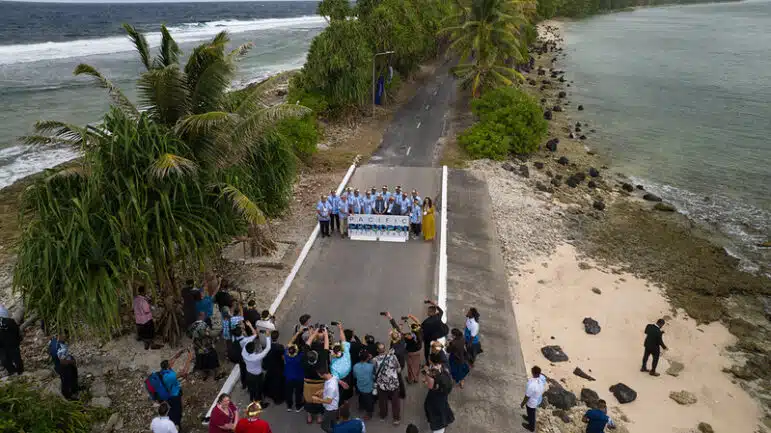
This urgency formed the backdrop for September’s “Pre-COP31” summit in Nadi, Fiji—the main preparatory gathering ahead of this year’s United Nations Climate Change Conference, or COP31, which will be held in Antalya, Turkey, in November.
The Fiji location emerged after a fierce debate between Australia and Turkey over COP31 hosting privileges. A deal last year designated Turkey as COP31 president and host of the coinciding world leaders’ summit. Meanwhile, Australia took on the newly-created role of “President of Negotiations,” promising to host the Pre-COP in the Pacific to highlight the region’s climate impacts and solutions.
Given their communities’ unique vulnerability, Pacific climate activists and governments have driven climate activism for decades. In the lead-up to the 1992 UN Framework Convention on Climate Change, Vanuatu, on behalf of the Alliance of Small Island States, pushed for developed countries to pay for “the financial burden of loss and damage suffered by the most vulnerable small island developing countries.” In 2025, after years of advocacy from Pacific youth and the government of Vanuatu, the International Court of Justice delivered a historic Advisory Opinion (ICJ AO) on the “Obligations of States in respect of Climate Change.” The ICJ AO has since been operationalized by the UN General Assembly.
An Ethical Call
Despite these incremental political and legal wins, the existential threat posed by climate change to Pacific land, sea and ways of life requires a deeper culture shift to drive ambitious action. CEE’s Samira Siddique, director of strategic initiatives, and Clara Chavez-Ives, research and policy associate, traveled to Fiji to ensure that values and culture were part of the conversation at this historic gathering.
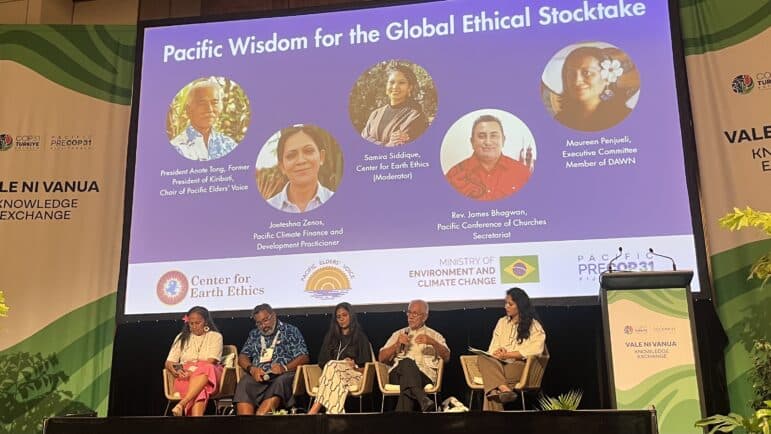
In Fiji, they highlighted the Global Ethical Stocktake during a panel in partnership with Pacific Elders’ Voice (PEV) and the Brazilian Ministry of Environment and Climate Change. The event, moderated by Siddique, featured contributions from Anote Tong, former president of Kiribati, PEV chair and current GES pro tempore leader; Reverend James Bhagwan, general secretary of the Pacific Conference of Churches; Maureen Penjueli, executive committee member of DAWN and moderator of the 2025 GES Oceania Regional Dialogue; and Joteshna Zenos, a Pacific climate finance and development practitioner.
Somewhere along the line, morality has become inconvenient. It has become inconvenient for people to reduce their footprint and their profit. Is our life worth less than your convenience?
Rev James Bhagwan
Tong noted that, when he began discussing climate change in the UN space in 2003, most nations were focused on terrorism. Now, he reflected, “we are talking about it, but not achieving.” He likened current circumstances to being onboard the Titanic. “Will we pull everyone onto the lifeboat or not?,” he asked. He also stressed how successive Intergovernmental Panel on Climate Change assessment reports have shortened projections of how long small island nations like his own will remain above water.
In the face of this threat, Bhagwan emphasized that spiritual communities are a powerful “untapped resource,” noting that 70% of people globally belong to some faith tradition. Yet, “somewhere along the line, morality has become inconvenient. It has become inconvenient for people to reduce their footprint and their profit.” Bhagwan implored, “is our life worth less than your convenience?”
The GES centers values that place people and planet over profit, with Penjueli describing the Oceania Dialogue as “the first time many frontline communities felt heard and seen by policymakers.” She also outlined the long history of Pacific leadership on moral issues, including nuclear testing and colonization. She drew a parallel between climate change and the situation in Gaza, remarking, “if moral clarity in the Pacific isn’t entrenched in other existential crises, then we will lose the climate fight.”
Spotlight on Pacific Leadership
Conference side events highlighted Pacific leadership, including “From Suva Climate Declaration to Paris to PEV: Leadership in Climate Action.” The panel, organized by PEV, featured comments from President Tong, Vishal Prasad, director of Pacific Island Students Fighting Climate Change, and Nunia Melissa Bari, a teaching assistant at UniFiji.
Others focused on the 2025 ICJ AO on states’ climate obligations, with experts emphasizing that the opinion requires countries to make sure their climate plans (Nationally Determined Contributions) are in line with a 1.5°C world. Dr. Sindra Sharma, the International Policy Lead at the Pacific Islands Climate Action Network (PICAN) warned that “what we’re seeing with scientific rollbacks is dangerous because it decouples the best available science from legal levers like the ICJ AO.”

Dr. Siobhan McDonnell, special advisor on resettlement and relocation for Vanuatu, called on all those present to implement the ICJ AO to avoid it becoming a talking point cited in speeches but not impactful in negotiations. “The Pacific does incredibly heavy lifting in this space,” she said. “The rest of the world should step up.”
Civil society groups from Oceania shared their “Common Agenda for COP31,” which included fighting against dangerous, distracting false solutions like deep sea mining. They emphasized holding Australian leadership accountable, ensuring that the country does not use its position as President of Negotiations to greenwash its record. Tzeporah Berman, chair of the Fossil Fuel Treaty Initiative, highlighted that the recently-announced coal mine expansion in New South Wales, like any new fossil fuel project, is inconsistent with the 1.5°C target and illegal under the ICJ AO.
Don’t do it just for the Pacific, do it for your children, too. Everyone knows the climate science. It’s awful and will only get worse. Let us make it matter.
Dr. Siobhan McDonnell
Looking Toward COP31
The formal negotiations in Fiji concluded with the adoption of The Taku Pakasoa Declaration: Strength in Unity. The statement from world leaders emphasizes the threats posed by breaching 1.5°C of warming (particularly for PSIDS), recognizes key court decisions like the ICJ AO and calls for structural changes to climate finance, including grant-based and concessional finance. However, there were no measurable funding commitments made, nor further development of written guidelines for country roadmaps to transition away from fossil fuels, leaving a lot to be addressed at COP31 in Turkey. In Fiji, UN Climate Change Executive Secretary Simon Stiell urged the world to mobilize “to keep the breach [of 1.5°C] as short and as small as possible.” Looking beyond the Pre-COP, he pointed to the COP31 Action Agenda, particularly the need for real investment in electrification from countries and business leaders to break free from fossil fuel dependency. The stakes have never been higher. As McDonnell said: “Don’t do it just for the Pacific, do it for your children, too. Everyone knows the climate science. It’s awful and will only get worse. Let us make it matter.”