
“A Movement of Movements”
Dispatches on Ethics and Action in New York
The Immorality of Inaction (September 18)
“We’re gathered here today to see clearly and to voice truth,” said Karenna Gore, founder and executive director of the Center for Earth Ethics, in welcoming guests to “Immorality of Inaction: Voicing Truth on Climate,” a public call-to-action on the climate crisis on Friday, September 18 at the historic Riverside Church on the Upper West Side.
Nobel Laureate and former Vice President Al Gore and Bishop William Barber II, president and senior lecturer at Repairers of the Breach and co-chair of the Poor People’s Campaign: A National Call for a Moral Revival, were the keynote speakers. Nearly 500 people, including faith leaders, Indigenous leaders, community organizers, activists and advocates, students and teachers attended the convening, held in the lead up to NYC Climate Week 2026 and the annual meeting of the United Nations General Assembly.
Everyone recognized the urgent need to confront the climate crisis. “We know that the consequences of man-made climate pollution are here now,” said Ms. Gore. “We could lose half of all of the living species on this Earth during our lifetimes,” warned Mr. Gore, the founder and chairman of The Climate Reality Project.
All the speakers noted the powerful interests thwarting action on climate change. “We know what we need to do,” said Bishop Barber. “But greedy corporations have flooded the zone.”
“In the face of this dishonesty—this blocking of our ability to act—we must not be silent,” said Ms. Gore.
Additional speakers at the event included Alexis Abramson, Roberto Múkaro Borrero, Swami Dayananda, Taylar Enlow, Paul Gallay, Gegye Yongyal Tulku Rinpoche, Sophia Powless, Charitie Ropati, Rabbi Jennie Rosenn, Samira Siddique, SD “Owl” Smith, Reverend Adriene Thorne, and Elizabeth Yeampierre.x
For more, read our full write-up about the event, or see the press coverage in New York Times, AMNY, APB News NYC and Scientific American. Ahead of “The Immorality of Inaction,” Karenna Gore joined NY1’s “Mornings on 1” to discuss the event.

Timothy Cross
Timothy Cross is director of operations and external relations at the Center for Earth Ethics.
Reawakening Humanity’s Sacred Relationship with the Earth (September 20)
On Sunday, September 20, 2026, the Fetzer Institute Environment Collaborative hosted “Reawakening Humanity’s Sacred Connection with Earth,” a full-day symposium uniting perspectives for bold climate solutions to address the climate crisis through spiritual and Indigenous worldviews.
In the afternoon, CEE Executive Director Karenna Gore moderated a panel on the spiritual dimensions of climate justice, featuring Roberto Múkaro Borrero, CEE strategic advisor and board president of United Confederation of Taíno People; Rabbi Jennie Rosenn, founder and CEO of Dayenu: A Jewish Call to Climate Action; Swami Dayananda, director of LOTUS (Light Of Truth Universal Shrine) Center for All Faiths; Samira Siddique, CEE director of strategic initiatives; and Taylar Enlow, CEE research and special projects assistant.
Siddique underlined that climate justice means centering those most affected by the crisis, including by drawing on spiritual concepts and engaging faith communities. Rabbi Rosenn emphasized “the critical role of spiritual communities” in understanding climate action as a moral obligation. She invoked the instruction from Deuteronomy, “צֶ֥דֶק צֶ֖דֶק תִּרְדֹּ֑ף, / tzedek tzedek tirdof”—“Justice, justice shall you pursue!” as a reminder that this work is one of ongoing responsibility and that no one undertakes it alone. Enlow closed on a similar note with the African philosophy of Ubuntu, “I am because we are”—which extends to both the human and the more-than-human family—and called on participants to build relationships across cultures and ways of knowing.
Clara Chavez-Ives
Clara Chavez-Ives is a research and policy associate at Center for Earth Ethics.
Rosie Semlyen
Rosie Semlyen is a research and policy associate at Center for Earth Ethics.
Women’s Water Walk
On the sunny morning of Sept 19th, nearly 100 people gathered in ceremony on the sloping bank of Arctic Lake in Oquaga Creek State Park in upstate New York to mark the beginning of the 108 mile, two-week long Women’s Water Walk.
Following the approximate route of the proposed Constitution Pipeline, the Women’s Water Walk is for the entwined purpose of raising awareness of the threats that the pipeline would pose to these lands and waters, and offering prayers and gratitude to the many rivers and waterways along the way.
The Constitution Pipeline would carry fracked gas from northeast Pennsylvania to Schoharie County, N.Y. It was introduced years ago but in 2016 New York State denied the construction permit, referencing the Clean Water Act and the potential ecological impacts of the pipeline. But in January 2026, under the Trump Administration, the EPA proposed policy changes that would affect the Clean Water Act, “eliminating regulatory overreach that has imposed unnecessary burden on critical infrastructure projects.” Riding on the corporate-power friendly policies of the current administration, the Oklahoma-based Williams Company is once again pushing for approval of the pipeline.
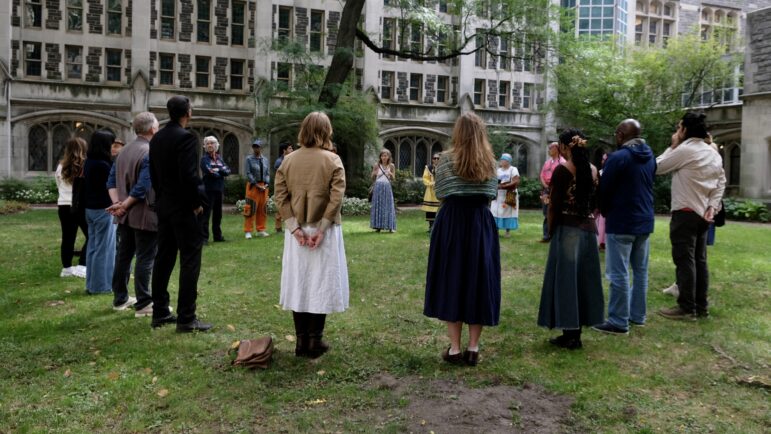
CEE supports the Water Walk, and we have been participating in many ways—doing community outreach to local religious communities, participating in press conferences and media, helping organize logistics and joining on the walk itself. On Saturday, September 19, CEE organized a ceremonial gathering and walk in solidarity with the Water Walk. Participants gathered at Union Theological Seminary, sharing words and songs, and pouring water into a shared vessel, which was then ceremonially offered to the Hudson River.
Rooted in prayer and positive action, the Walk has been full of singing and prayer, stopping often to make offerings to the rivers and streams along the way, and hosting community education events in the evenings in towns along the route.
If you are nearby, please join us! You are invited to join for one day or for many.
For more information, visit the Women’s Water Walk website, read about it in the press, or watch the official press briefing.

Tory Field
Tory Field is a research and teaching associate at Center for Earth Ethics.
Global Ethical Stocktake Technical Roundtable (September 23)
On Wednesday, September 23, Brazil’s Ministry of the Environment and Climate Change hosted a technical roundtable on the Global Ethical Stocktake (GES) at the Permanent Mission of Brazil to the UN. Initiated by Brazil ahead of COP30, the GES brings ethics, values and a wider range of voices into climate policy.
João Paulo Capobianco, the Brazilian Minister of the Environment and Climate Change, welcomed government representatives from across the world, with former Minister Marina Silva joining by video, and former President of Ireland Mary Robinson and former President of Kiribati Anote Tong opening the discussion.
Karenna Gore, who served as GES co-leader for North America alongside Minister Silva, reflected that the world is not short of knowledge about what the science requires. She echoed the framing of the GES as “a movement of movements” that seeks to generate what’s missing: the conscience and collective will to act. The roundtable looked ahead to the next phase of the GES, which aims to inform the second Global Stocktake (GST2) and will depend on broadening support from nations. Alongside this governmental track, CEE will continue to develop the GES social mobilization track as Executive Secretariat, supporting the pro-tempore leadership of President Tong of Pacific Elders’ Voice and broader movement-building efforts on the spiritual, ethical, and cultural dimensions of the climate crisis.

Clara Chavez-Ives
Clara Chavez-Ives is a research and policy associate at Center for Earth Ethics.
Rosie Semlyen
Rosie Semlyen is a research and policy associate at Center for Earth Ethics.
Arctic Voices: From Alaska and the Circumpolar North (September 23)
On September 23rd, Native Movement and Indigenous organizers from the Circumpolar Arctic for “Arctic Voices: From Alaska and the Circumpolar North,” led a day-long gathering at Union Theological Seminary, that Center for Earth Ethics co-sponsored. Speakers shared about their cultural lifeways and wellbeing, interconnection with one another and the land, and the impacts of climate change and extraction in the Arctic.
The morning began with a conversation offering different perspectives on the fundamental role of ceremony in culture. “Ceremony is where our value system lives” said Louise Brady (Kh’asheech Tláa), the founder of the Herring Protectors of the Sitka Tribe of Alaska, who recognize the herring as the “foundation of our cultural, spiritual, and ecological ecosystem.” Aka Hansen, an Inuit organizer and filmmaker from Greenland noted that, “ceremony is relational. It’s giving back instead of taking.”
Much was shared about ways of life that are focused on being in good relationship with the land. “If you slow down and sit at the pace of healing and the pace of creation,” said Eva Dawn Burke “there is an energy exchange. Collective healing is bringing people back onto the land.”
The day continued with a panel about current organizing against extractive projects in the Arctic, including numerous examples of false solutions which are being portrayed to the public as ‘green’ projects—but which will in fact have damaging ecological effects. Sámi organizer Aslak Holmberg, from the border between Finland and Norway, spoke of the struggle against the Nussir copper mine, being constructed to access minerals needed for “green energy, digital, aerospace and weapons sectors.” The mine has been licensed to pipe between 1-2 million metric tons of mining tailings annually into the bottom of a national salmon fjord that Sámi communities rely on for fishing. Holmberg also spoke about a highly contested Equinor project to electrify Europe’s largest liquefied natural gas processing plant. The project is being touted as part of Norway’s green transition but opponents say there are many hidden costs to Sámi lands and to the climate at large. Oil Change International noted that the electrification will ultimately extend the plant’s operating life by 20 years, thereby contributing to an even larger overall carbon footprint.
The event was organized by Native Movement, an organization based in Alaska dedicated to Indigenous Peoples’ rights and the rights of Mother Earth.
Tory Field
Tory Field is a research and teaching associate at Center for Earth Ethics.
BIPOC Climate Justice Summit: Climate Democracy Frontiers (September 26)
On Saturday, September 26, CEE joined Columbia Climate School, HBCU Green Fund, ACE Observatory and dozens of frontline organizations in co-sponsoring the sixth annual “BIPOC Climate Justice Summit: Climate Democracy Frontiers” at the American Museum of Natural History. The summit, which took place in the Hall of the Universe of the Museum, convened frontline communities who experience climate impacts “first and worst.” Ironically, the summit unfolded at the height of a Nor’easter storm passing through New York City, with the sound of thunder and heavy rain echoing during panel talks.
Samira Siddique, CEE director of strategic initiatives, moderated two panels during the summit, which spanned a range of climate issues: climate finance, knowledge production, land rights, and climate misinformation. The first panel that Siddique moderated, on “culture as resistance” included a conversation on creating new climate power narratives through music, food, art and activism with culture workers and artists Nataani Means, Ietef Vita/ DJ CaveM, Vatic Kuumba, and Anais Reyes. This conversation highlighted the powerful role that BIPOC artists and activists play in bringing lesser known stories, traditions and ways of life into mainstream understandings of the climate crisis. The discussion also touched on the tensions of the urgency to act in the climate crisis, alongside a broader crisis of human rights, with the patience and time required to have a consistent creative practice.
The second discussion was a closing keynote panel: “Building the next frontier of the climate justice movement.” Climate leaders from Ecuador, Nepal, Pakistan, Puerto Rico and the United States—Jacqui Patterson, Abhishek Shrestha, Ayesha Siddiqa, Thalia Cachimuel, and Isatis Cintron-Rodriguez—discussed how to make the climate justice movement more resilient. Speakers emphasized the importance of local community voices and intergenerational perspectives at every step of policy processes. In the face of restrictive and exclusionary policy environments, frontline communities must organize parallel advocacy spaces.
This full day public event was part of AMNH’s ClimateFest, closing out NYC Climate Week with community events that brought the science of climate change in conversation with its human impacts.


Samira Siddique
Samira Siddique is director of strategic initiatives at Center for Earth Ethics