
New York Rolls Back Landmark Climate Legislation
After months of negotiation, New York Governor Kathy Hochul used the budget process to blunt the state’s climate law
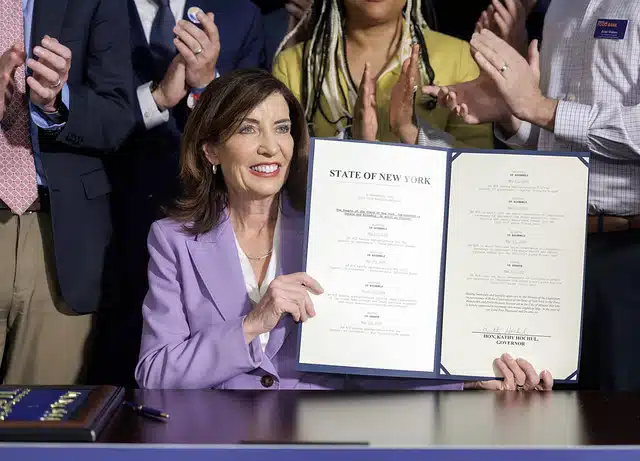
On May 28, New York Governor Kathy Hochul signed the state’s fiscal year 2027 budget into law. Just two days earlier, the state legislature approved major climate rollbacks in one of the ten bills that make up the budget. The passage of the Transportation, Economic Development and Environmental Conservation (TED) bill marked the end of a months-long fight between the Governor and the State Senate and Assembly. Coming nearly two months after the April 1 deadline, the finalized budget, specifically the TED bill, includes changes to key provisions of the Climate Leadership and Community Protection Act (CLCPA), the state’s landmark climate law.
Passed in 2019, the CLCPA set strong, legally-binding climate goals for New York State. These included:
- Reaching 100% carbon-free electricity by 2040, with 70% from renewables by 2030
- Achieving an 85% reduction in greenhouse gas emissions by 2050, with the remaining 15% offset, and setting an interim emissions reduction of 40% by 2030
- Ensuring disadvantaged communities receive 40% of “the overall benefits of spending on clean energy and energy efficiency programs, projects or investments”
A Record of Backsliding
Hochul has been slow-walking the state’s responsibilities under the CLCPA for years, claiming that climate action is too expensive. The New York State Department of Environmental Conservation was supposed to develop greenhouse gas emissions reduction regulations by the beginning of 2024, but the state blew past the deadline. In March 2025, environmental organizations sued, claiming the delay defied the legislature and harmed New Yorkers’ health. In October 2025, a state Supreme Court judge ruled that the state was in violation of the CLCPA and must release new regulations by early February 2026. The Governor appealed this decision, again buying the government more time.
On March 20, amidst this rising pressure, “Empire Report” published an op-ed by the Governor officially proposing rollbacks to the law. Hochul used the piece to tout her climate accomplishments—for example, “more than $88.7 billion […] invested in clean energy” and “the first-ever utility-scale offshore wind farm in the United States.” While she claimed to be “fully committed to the blueprint for a sustainable future” articulated in the CLCPA, the Governor argued for “common-sense adjustments” to keep this future affordable. To justify backsliding, Hochul pointed to COVID-induced supply chain disruptions and inflation, federal policy shifts under Trump and the conflict in Iran.
Hochul’s alternative vision included a ratepayer protection plan and an “all-of-the-above approach to energy that includes more renewables, emission-free, reliable round-the-clock nuclear, and other needed power sources.” She detailed three specific changes to the CLCPA:
- Putting off developing greenhouse gas regulations until the end of 2030
- Weakening the state’s 2040 emission target
- Changing how the state calculates methane emissions
Hochul has been slow-walking the state’s responsibilities under the CLCPA for years, claiming that climate action is too expensive.
Legislators Hesitate, and Activists Push Back
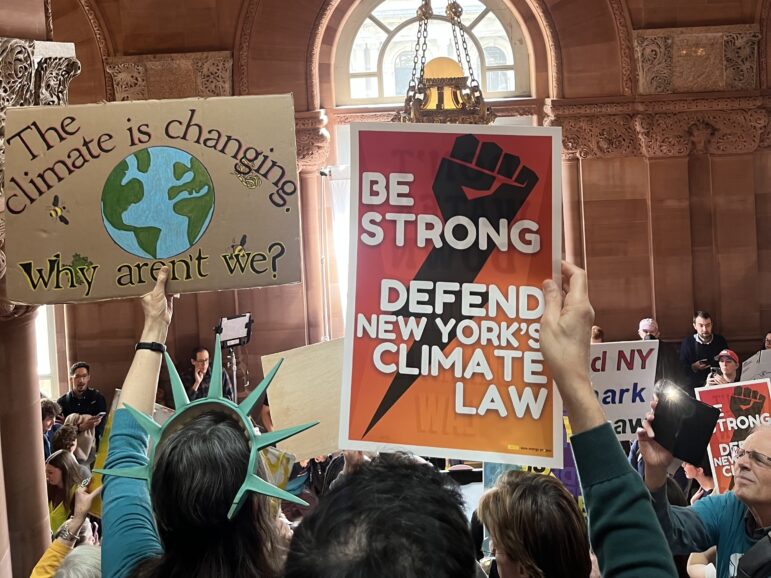
Many Democrats appeared initially hesitant to change the climate goals, while the Senate Minority Leader Rob Ortt pushed for a full repeal. Less than a week after Hochul’s op-ed was released, more than 20 legislators joined hundreds of activists in Albany to demand that the Governor uphold the ambition and obligations of the CLCPA. Several people, including Raj Goyle, a candidate for state comptroller, were arrested.
Speaking at the rally’s press conference, elected officials criticized Hochul’s reasoning, raised concerns for environmental justice communities and called on the Governor to work with them. Assemblymember Deborah Glick, chair of the Assembly Environmental Conservation Committee, pointed out that “while economic conditions have evolved since 2019, the science has not.” She also noted that “adjusting the accounting simply obscures the true impact of emissions. Meanwhile, the ongoing volatility of fossil fuel prices continues to drive instability for consumers, underscoring that the most reliable path to affordability is accelerating our transition to renewable energy.”
Senator Pete Harckham, chair of the Senate Environmental Conservation Committee, reiterated that “our climate laws did not cause the affordability crisis we face; in fact, independent studies point to fossil fuels as a key driver.” This point was especially timely given that a February 2026 memo from New York State Energy Research and Development Authority (NYSERDA) claimed that implementing the CLCPA could cost everyday New Yorkers thousands of dollars annually. A March 2026 memo from the NY Renews coalition, meanwhile, found that delaying implementation would cost 30,000 jobs per year and billions in lost energy bill credits and rebates, as well as contributing to devastating health impacts.
Faith groups were among the activists resisting the rollbacks. Jeff Levy-Lyons and Wendy Seligson, co-directors of Jewish Climate Action Network NYC, noted that “by standing strong, our elected representatives show that they understand the moral imperative of the climate emergency and the urgency of preserving and protecting the well-being of New Yorkers today and in future generations.” In April, nearly 100 faith leaders and clergy members wrote to the Governor opposing the rollbacks. GreenFaith also organized a rally in New York City to resist the changes.
Our climate laws did not cause the affordability crisis we face; in fact, independent studies point to fossil fuels as a key driver.
Senator Pete Harckham
What’s Next for New York?
On May 7, the Governor claimed that a deal had been reached on the budget—a statement which was shortly after contested by Assembly Speaker Carl Heastie, who clarified that the legislature had yet to agree to anything “major” and further emphasized that “budgets are supposed to be about money, not policy.” His comments highlighted the tension between the executive and other lawmakers over Hochul’s method of forcing policy changes, in addition to the changes themselves.
While Hochul’s announcement was premature, the final budget three weeks later included the rollbacks she had lobbied for, with only minor changes.
- New York postponed the release of its emissions regulations, originally due at the beginning of 2024, until the end of 2028.
- The legislation includes loopholes in the state’s 2040 emissions reduction target of 60%, specifically that the state need only meet the goal “to the maximum extent feasible and cost effective.”
- It diluted the state’s methane accounting timeframe from 20 to 100 years. While the 100-year method is widely used, many scientists favor the 20-year approach because methane emissions contribute much more strongly to short-term warming than carbon dioxide, making a shorter timescale a more accurate assessment of the greenhouse gas’s threat.
Hochul’s rollbacks call into question New York’s future as a climate leader, especially in an era of federal backsliding. Notably, Hochul did not face strong pushback from some key political leaders. When she initially proposed changing the methane accounting timeframe in 2023, then-Assemblymember Zohran Mamdani argued that “Governor Hochul should be leading our state to actually meet its mandates. We can’t get out of the climate crisis with accounting tricks and greenwashing.” In a stark departure from his tenure in the Assembly, now-Mayor Mamdani stayed conspicuously quiet throughout the climate law fight this spring. Congresswoman Alexandria Ocasio-Cortez, known for supporting a “Green New Deal,” was also silent. This climate hushing is particularly concerning since the world is expected to face dangerously hot temperatures during the Northern Hemisphere summer, driven by greenhouse gas emissions and exacerbated by a likely El Niño event.

Where We Stand
In addition to the CLCPA rollbacks, there were several key environmental bills at play during the legislative session, which concluded on June 5.
- The legislature approved the Responsible Data Center Development Act, which would institute a one-year moratorium on new data center construction, giving the state time to develop an environmental impact report. Hochul has yet to sign the bill.
- Lawmakers passed the Solar Up Now New York (SUNNY) Act, which would allow New Yorkers to install solar panels on their windows and balconies. Hochul has yet to approve this, but similar legislation is popping up around the country, including a bill in Connecticut, which was signed into law on June 4.
- The Accelerate Solar for Affordable Power (ASAP) Act was passed as part of the budget agreement. This would speed up the interconnection process for distributed solar projects.
- The Packaging Reduction and Recycling Infrastructure Act (PRRIA)—which would introduce plastic packaging controls and extended producer responsibility rules—failed to pass for the third year in a row.
Regardless of the support a bill has in the legislature, the Governor maintains immense power, particularly for legislation passed at the end of the session. For bills passed before the last ten days of the legislative session, Hochul has ten days to sign or veto a bill. If she chooses not to act, these bills become law automatically. If she vetoes a bill, it can still become law by garnering a two-thirds vote in both the Senate and Assembly. The Governor can also agree to sign legislation with a “chapter amendment,” where the legislature agrees to changes to the bill in exchange for its passage. For bills passed at the end of or outside of the session—like many of the aforementioned ones, given how late the budget negotiations concluded—Hochul is given 30 days to act. Should she fail to do so, this serves as a “pocket veto,” allowing her to reject a bill without having to take much accountability.
Hochul’s reticence to focus on climate concerns is significant in the context of her reelection campaign this year. Thus far, she has emphasized affordability issues. As Assemblymember Sarahana Shrestha noted, however, “the Governor is choosing to not make energy affordable for a while because the more we are tied to fossil fuels the more we are having to pay for fossil fuel infrastructure.” Notably, Hochul’s Lieutenant Governor Antonio Delgado, who was more progressive on environmental issues, dropped his primary challenge after failing to rally sufficient support. Some advocates worry that Hochul’s success in rolling back CLCPA provisions will signal to other governors that pivoting away from climate leadership is palatable. As midterm elections play out across the country in November, it will be telling to see what messaging wins out.