
Accountability, Responsibility and the Earth in Trust
Fordham Panel Explore Legal and Interfaith Perspectives on the Climate Crisis
“Earth is not an inert set of resources,” said CEE Executive Director Karenna Gore. “Our lives depend on the health of the biosphere.”
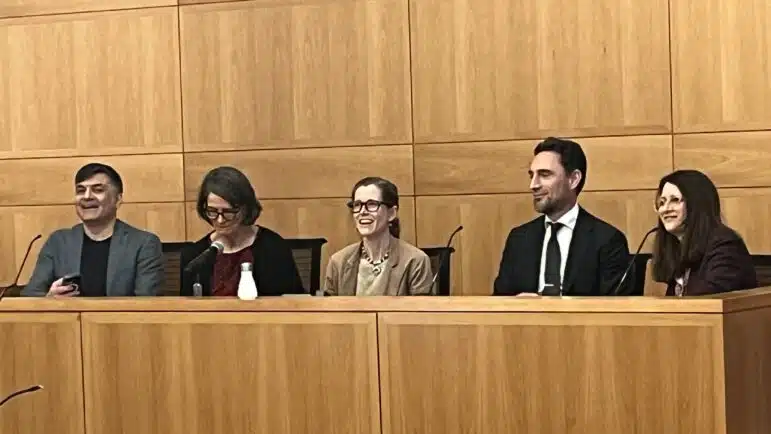
Gore made this observation at “The Earth in Trust: Law, Faith Traditions, and the Work of Environmental Accountability,” an interdisciplinary conversation held on Thursday, April 23, at Fordham Law School in Manhattan. Gore was joined by Adam D. Orford (Fordham Law School), Kit Kennedy (NRDC) and Hakan Yesilova (The Fountain Magazine). Endy Moraes, director of Fordham University’s Institute on Religion, Law & Lawyer’s Work, moderated.
The discussion explored how interfaith perspectives and legal expertise can engage the urgent challenges of environmental and climate justice. Moraes explained that, when Earth is seen as “a shared system” where people are “not absolute owners, but stewards,” a central task is “explaining how responsibility and accountability are structured.” “What does responsibility require in a world that is interconnected?” she asked.
Gore embraced the notion of the Earth held in trust, calling for “responsible stewarding” of the planet. She pointed to the powerful role for people of faith in addressing the climate crisis. “How many movements of the past have come out of faith communities?” she asked. While the “way of the world—what you can get away with”—predominates, faith communities offer “different conceptions of wealth and poverty” that are “more sane and more fair for the whole.”
Orford, an associate professor of law at Fordham, emphasized the “difficult ethical and moral question” underlying the discussion. “The Earth is held in trust for whom?” he asked. Noting that people, animals, plants, forests and rivers have all been advanced as stake-holders, “who deserves to have moral standing in our decision-making beyond ourselves?” he asked. “We have to have these conversations before we decide what the law has to do.”
Earth is not an inert set of resources. Our lives depend on the health of the biosphere.
Karenna Gore
Moreover, Orford insisted on the “responsibilities of nation states” in addressing the climate crisis. He “finds more encouragement in international processes than domestically.” In the U.S., we need to “encourage participation in our democracy and work to change our laws.” Given “the lack of connection to the world around us,” which is encouraged “by the system of global trade,” people need to “get connected to the world that they actually live in.”
Kennedy, who heads the newly formed Power Division at NRDC (Natural Resources Defense Council), lamented that the Trump Administration’s environmental damage “surpasses our ability to be shocked.” The damage includes not only the rollback of environmental protections but also damage to government agencies and authorities designed to “protect us.” She emphasized that “tools to fight back” remain, especially litigation and regulatory activity.
Most importantly, she insisted that the crisis requires “a different political discourse.” In the current political landscape, “are we all as politically active as we should be?” she asked.
Even if I didn’t have hope, I would continue this work because it is the right thing to do.
Adam Orford
The notion of “trust” is “about using our reason,” said Yesilova, editor in chief of “The Fountain Magazine,” a bi-monthly journal of science, faith and culture. The Koranic approach to humankind, he said, treats plants and animals as “nations, moral communities,” with “an ontological right to exist and flourish.” He understands The Koran as warning against “going beyond the limits” of the balance with nature.
“We need to have more incentives to mobilize people,” he said. “Humankind can learn how to right themselves, to be more respectful.”
Despite our frequently grim news cycle, the panelists expressed both hope and determination. “Life is so powerful, and if we give it an opportunity, it will come back,” said Yesilova. Kennedy saw “momentum of growing interest” in environmental issues. And Gore found hope in nature itself. “It’s a beautiful thing to see what an interconnected world we live in,” said Gore.
“Even if I didn’t have hope,” offered Orford, “I would continue this work because it is the right thing to do.”
