
Permitting Reform: Renewable Energy Catalyst, or Pandora’s Box?
New York Governor Kathy Hochul’s State of the State and Executive Budget raise concerns over green development.
Background
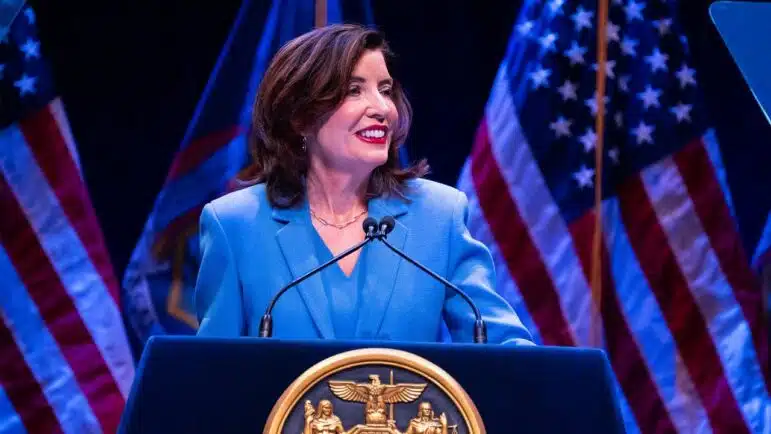
New York Governor Kathy Hochul’s annual State of the State address on January 13—her last before the November election—and her Fiscal Year 2027 Executive Budget, released the following week, did not address climate change directly. But several environmental topics, viewed through an affordability lens, were among her priorities for the current legislative session, which lasts from January to June. Hochul called out President Trump for his stop-work orders on offshore wind, noting how they make it hard for people to keep the lights and heat on. She announced an effort to have data centers pay their “fair share” for the energy they use, or, ideally, to have them generate their own power. And she leaned into nuclear and hydropower as clean energy solutions.
Perhaps Hochul’s most notable suggestion was to take “a hard look at environmental review processes,” which she sees as slowing down climate projects. This focus echoes debates around permitting reform occurring across the country at the state and federal levels.
Underwhelming State Leadership
Despite her brief acknowledgement of the climate crisis, many environmental advocates were disappointed with Hochul’s priorities and demanded more from the governor. In a press release, NY Renews—a coalition of more than 300 environmental, labor and faith groups from across the state—called on Hochul to uphold the state’s Climate Law and to launch the cap-and-invest program to help lower energy costs, upgrade buildings, and create green jobs.
New York State’s Climate Law, or the Climate Leadership and Community Protection Act (CLCPA), was passed in 2019, with the overarching goals of reaching “100% zero-emission electricity” by 2040 and reducing emissions “at least 85% below 1990 levels” by 2050. The proposed cap-and-invest program (now called the Clean Air Initiative) would cap greenhouse gas emissions, charging emitters for violations and investing the penalties into climate efforts.
Despite widespread support for this program, Hochul has been stalling. The deadline to finalize regulations was the beginning of 2024; however, it took until June 2025 for public comment to be opened for just one of the three sets of regulations. Then, at the end of 2025, Hochul appealed a state supreme court decision that ruled that the Department of Environmental Conservation (DEC) broke the law by failing to release the regulations in 2024. The state now has until June 2026 to explain its reasoning, with Hochul allegedly considering changes to the CLCPA during the 2026 session.
Rather than urgently implementing the climate action that New York law already requires, and that she already committed to, Hochul is pivoting to a development-oriented policy, with unclear implications for communities and the environment.
Hochul also reneged on what advocates already considered to be compromise measures. For example, the FY27 Executive Budget included no new allocation to the Sustainable Future Program, which saw an initial $1 billion invested last year. When the details were announced in September 2025, NY Renews expressed appreciation for funding of initiatives like EmPower+ (which helps with no-cost home energy assessments and energy efficiency upgrades), tempered by frustration that the Sustainable Future Program did not match the revenue that would come from a robust cap and invest program. The New York City Environmental Justice Alliance (NYC EJA), a member of the coalition, emphasized this in January 2026 testimony, pushing for another $3 billion for the Sustainable Future Program “as a substitute for the lack of recurring Cap Trade and Invest (CTI) revenue that was intended to raise billions of dollars annually for cost saving climate investments in our communities.”
This context helps explain why many environmental and frontline advocates feel let down. Rather than urgently implementing the climate action that New York law already requires, and that she already committed to, Hochul is pivoting to a development-oriented policy, with unclear implications for communities and the environment.

Permitting Reform: A National Debate
Permitting reform—efforts to speed up the approval process for major infrastructure projects—is a major environmental debate. At the national level, the issue received significant attention in 2022 during negotiations over the Inflation Reduction Act (IRA). The IRA ultimately became law in August 2022, with then-Senator Joe Manchin (D-West Virginia) securing a commitment from Democratic leadership to pass permitting reform measures by the end of September 2022.
Indigenous groups across the country opposed Manchin’s permitting reform proposal, the Energy Independence and Security Act of 2022. A NDN Collective analysis highlighted concerns about reduced tribal consultation and self-governance, as well as restricted public comment requirements. The Indigenous Environmental Network (IEN) described the proposal as “a side-deal that prioritizes the oil and gas industry over the lives of people… [and] puts Tribal communities at risk.” IEN specifically pointed to Manchin’s backwards logic that the Mountain Valley Pipeline was necessary for an energy transition and carbon emissions reductions. While Manchin eventually withdrew his initial proposal, he pushed another measure through at the end of the year, losing a December Senate vote. Later, he introduced the Energy Permitting Reform Act of 2024 (EPRA). Although it didn’t pass, EPRA, alongside other permitting reform efforts, was critiqued by environmental justice leaders for “[silencing] the voices of those most impacted by fossil fuel projects by restricting their ability to challenge harmful decisions in court.”
Hochul has been heavily lobbied by the fossil fuel industry and has indicated a willingness to allow the buildout of harmful fossil fuel infrastructure.
NEPA in the Spotlight
At the center of federal permitting reform proposals is the National Environmental Policy Act (NEPA). Enacted in 1970, NEPA “requires federal agencies to assess the environmental effects of their proposed actions prior to making decisions.” While NEPA was hailed as a historic measure to prevent reckless environmental destruction, over the decades, it has also gained a reputation for slowing down all kinds of infrastructure buildout. Fossil fuel proponents criticize NEPA for holding up pipelines, while some renewable energy advocates complain that the same system is blocking wind and solar projects.
In recent years, attacks on NEPA have intensified from all branches of government. In May 2024, the U.S. Supreme Court ruled in Seven County Infrastructure Coalition v. Eagle County that “courts must give federal agencies ‘substantial judicial deference’ when reviewing NEPA documents, and that NEPA does not require agencies to consider the environmental effects of upstream or downstream projects that are separate in time or place from the proposed action subject to NEPA review.” In a January 2025 executive order, President Trump targeted NEPA regulations, pushing for sped-up permitting processes. In Congress, the July 2025 One Big Beautiful Bill Act allowed project sponsors to pay for expedited environmental assessments. Additionally, in December 2025, the House passed the Standardizing Permitting and Expediting Economic Development Act, looking to reform both NEPA processes and related judicial activities. As of early 2026, lawmakers on both sides of the aisle are working on a permitting reform deal. Given the narrow Republican majority in the Senate, any permitting package will likely have to include renewables to garner the necessary Democratic votes.

In September 2025, New York City-based environmental justice organization WE ACT released a StoryMap report arguing against weakening NEPA and combating the notion that NEPA is responsible for delaying projects. Instead, WE ACT found that “failure to conduct early and meaningful community engagement, a lack of funding and staffing within agencies responsible for NEPA implementation, and lack of interagency coordination are the primary causes of project delays.” WE ACT further emphasized how deregulation can result in renewable energy projects that create the same burdens in environmental justice communities as fossil fuel projects.
Hochul’s Ethical Responsibility
Given this national landscape of environmental rollbacks, it’s critical to monitor Hochul’s approach to permitting reform. Her recently announced “Let Them Build” agenda aims to amend the State Environmental Quality Review Act to speed up housing development, an approach that’s dividing environmental groups. While this differs from federal permitting debates over fossil fuel infrastructure, faster timelines must not come at the expense of community input and consent, or environmental protections.
Hochul argues that permitting reform is necessary for “the very projects that help us fight climate change, create housing and strengthen our communities.” However, she has been heavily lobbied by the fossil fuel industry and has indicated a willingness to allow the buildout of harmful fossil fuel infrastructure. This “all of the above” energy approach raises concerns about what streamlined permitting could enable beyond wind and solar. As fights over projects like the Northeast Supply Enhancement and Constitution pipelines resurface, the stakes of permitting reform extend beyond efficiency. Ultimately, it will signal whether New York’s climate transition is guided by its legal commitments or whether the state risks perpetuating sacrifice zones under a greener name.
Over the coming months, the New York State Assembly and Senate will negotiate budget details before its final submission, due on April 1. This is an opportunity for legislators to stand up for budget measures that invest in key climate programs. This is also a key time for constituents to hold lawmakers accountable, with activists planning days of action on March 10 and March 25 in Albany. It’s not too late for New York to show strong climate leadership!