The food we eat, the water we drink and the medicines we rely on all depend on a living world that is coming apart. According to WWF’s 2026 Living Planet Report, monitored wildlife populations have decreased by an average of 73% since 1970. Species in rivers, lakes and wetlands have declined by 85%. Around one million of the world’s estimated 8 million plant and animal species now face extinction, many within decades. These losses are felt hardest by the people who depend most directly on the natural world, including fishing and farming communities as well as Indigenous Peoples, whose food, livelihoods and cultures are tied to the health of the land and waters around them.
In October, governments met at the 2026 UN Biodiversity Conference, CBD COP17, in Yerevan, Armenia, to assess whether they are on course to halt and reverse this decline by 2030, as they pledged to do in 2022. The evidence showed they are not.
What Is CBD COP?
Global efforts to address this crisis began more than three decades ago. In 1992, at the Earth Summit in Rio de Janeiro, world leaders opened two landmark treaties for signature: the UN Framework Convention on Climate Change (UNFCCC) and the Convention on Biological Diversity (CBD). A third, the UN Convention to Combat Desertification (UN CCD), followed soon after. Known together as the Rio Conventions, these agreements address three interconnected crises: a changing climate, the loss of the living world and the degradation of land.
The UN Biodiversity Conference, or CBD COP, meets every two years. There, the 196 governments that have joined the treaty decide how to conserve species and ecosystems, use nature sustainably and share fairly the benefits that come from nature’s genetic resources, such as the plant and microbial genes used to develop medicines and crops. The most significant outcome of these meetings to date has been the Kunming-Montreal Global Biodiversity Framework (KMGBF), adopted at COP15 in Montreal in December 2022. Often described as the “Paris Agreement for nature,” it sets four goals for 2050 and 23 targets for 2030, ranging from cutting pollution and reforming harmful subsidies to restoring degraded ecosystems. One of its best-known commitments is Target 3, or “30×30”: to effectively conserve at least 30 of the world’s land, inland waters, coasts and oceans by 2030.
Held at the halfway point of the Kunming-Montreal framework, COP17 marked the first global review of whether countries’ promises are turning into action on the ground.
Photo: IISD/ENB - Mike Muzurakis
Taking Stock
The evidence going into Yerevan was sobering. The UN’s global report on collective progress found the world dramatically behind schedule to reach the KMGBF’s targets by 2030. On the 30×30 target, for example, protected areas cover only 19% of land and 10% of the ocean.
Countries responded by agreeing on the “Yerevan Pathway,” adopted after a closing plenary that ran nearly 12 hours. It urges governments to accelerate implementation, align national budgets with the KMGBF and reform subsidies harmful to nature, though only “in accordance with national circumstances.”
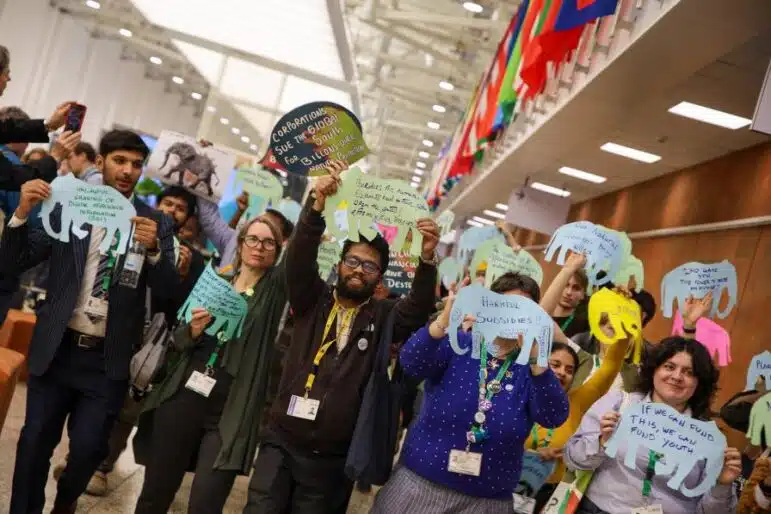
Finance was the hardest fight. Wealthy countries missed their target of $20 billion a year in biodiversity finance by 2025, with talks dominated by a discussion whether emerging economies should also become donors. A permanent financial mechanism was agreed in principle, but the delegates deferred the final decision as to its form. Civil society groups, including Friends of the Earth International and Third World Network, argued that these debates avoid the “elephants in the room”: a financial system that pressures governments toward extractive development; trillions of dollars in harmful public and private financial flows; legal systems that prioritize investor protections over environmental regulation; and growing reliance on market-oriented biodiversity finance mechanisms that often fail to address the underlying causes of biodiversity loss.
There were other setbacks. Delegates dropped references to the International Court of Justice’s 2025 climate advisory opinion and weakened cooperation among the Rio Conventions. A Chilean delegate expressed “deep concern in the steps we are taking back,” adding that “we are erasing with our elbow what we have just written.”
Advancing a Global Ethical Stocktake
On Tuesday, October 27, CEE hosted a side event, “Advancing a Global Ethical Stocktake: Conserving Biodiversity as a Moral Imperative.” Launched in the run-up to the 2025 UN Climate Change Conference in Brazil, the Global Ethical Stocktake, or GES, asked youth, elders, Indigenous leaders, artists, scientists and faith representatives what deeper values should guide action on our planetary crises.
Building on the GES, the panel examined three blind spots in biodiversity governance: whose values and knowledge count, the drivers of nature loss that negotiations avoid, and the cultural shift needed to move beyond extractive economies toward ones grounded in care and ecosystem restoration. Siddique moderated a conversation with Borrero; Doug Weir, director of the Conflict and Environment Observatory; María José Lubertino, president of the Asociación Ciudadana por los Derechos Humanos (Citizens’ Association for Human Rights) and member of the UN Women’s Major Group; and Alexandra Masako Goossens-Ishii, program coordinator for environment, climate change and biodiversity at Soka Gakkai International and co-lead of the Faiths for Biodiversity coalition.
Human well-being is inseparable from the health of the river, of the forest, of the glacier, of the soil, of the wetland
Borrero stressed the authority of Indigenous Peoples over their lands, warning against “fortress conservation” and projects imposed from outside. Lubertino spoke from an ecofeminist perspective, emphasizing the violence faced by environmental defenders, and described community care, food sovereignty and “buen vivir” (“living well”) as alternatives to measuring progress through extraction. Goossens-Ishii demonstrated how narrow, short-term ideas of security and value shape what governments are prepared to protect. Weir argued that peace and security belong in biodiversity discussions, and warned that treating nature as a national-security issue can obscure the damage that military activity and armed conflict inflict on ecosystems, from military emissions to conflict-related pollution. Speakers named harmful subsidies, corporate influence, conflict and weak accountability as key barriers, and pointed instead to rights-based governance, finance that reaches communities directly, and restoration led by those most affected.
Article 8(j): A Seat at the Table
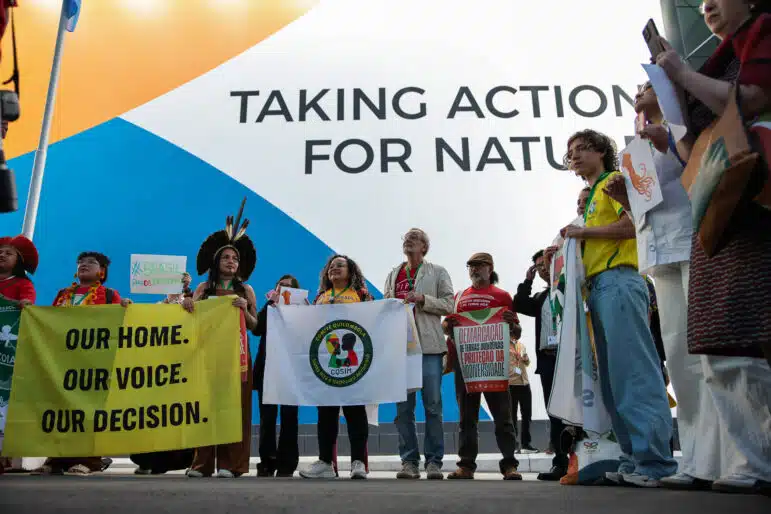
Article 8(j) of the 1992 biological diversity convention commits governments to respect, preserve and maintain the knowledge, innovations and practices of Indigenous Peoples and local communities embodying traditional lifestyles, and to share fairly the benefits that flow from them. Indigenous Peoples and local communities steward at least a third of the world’s key biodiversity areas, yet for decades their CBD participation ran through a temporary working group. At COP16 in Cali, Colombia in 2024, after nearly 30 years of advocacy, governments created a permanent Subsidiary Body on Article 8(j), giving Indigenous Peoples and local communities a standing forum to advise the COP and help prepare draft decisions.
In Yerevan, CEE Strategic Advisor Roberto Múkaro Borrero, chief of the Guainía Taíno Tribe, president of the United Confederation of Taíno People, and associate director of the International Indian Treaty Council (IITC), followed the process closely. After two weeks of negotiations, the governments that are Parties to the Convention adopted operating procedures for the permanent Subsidiary Body on Article 8(j). One co-chair will be nominated by Parties and the other through Indigenous Peoples’ and local communities’ own procedures, though both must then be formally elected by the COP, where only governments hold a vote.
Co-Chair of the contact group on Article 8(j) Jennifer Tauli Corpuz, International Indigenous Forum on Biodiversity. Photo: IISD/ENB - Mike Muzurakis
Photo: IISD/ENB - Mike Muzurakis
The compromise left significant concerns unresolved. The nomination rules include a country-based qualification that IITC considers a risk to independent Indigenous organizations operating abroad or in exile. Decisions on the composition, selection and working arrangements of the Friends of the Bureau were deferred until the next conference. The outcome did not secure the explicit allocation supported by IITC and the Arctic and North American regional caucuses: seven Indigenous seats, one for each sociocultural region, and three separately selected local-community seats.
Parties also adopted the separate Sevan Guidelines on Indigenous and traditional territories. Although useful safeguards remain, the final compromise deleted proposed language on human rights, customary governance, and consent, which IITC considers a substantive weakening.
Related concerns arose in the negotiations on marine biodiversity. In the provision governing invitations to outside experts for a new advisory group on marine biodiversity beyond national jurisdiction, explicit references to Indigenous Peoples and local communities, women, and youth were replaced by generic stakeholder language, though these groups are still mentioned elsewhere in the marine text.
Restoration Day
The 30×30 target commits countries to restoring at least 30% of degraded land, freshwater, coastal and marine ecosystems by 2030. On October 29, the CEE team joined Restoration Day at the Global Biodiversity Framework Pavilion, hosted by the UN Decade on Ecosystem Restoration.
The day saw the launch of the first Restoration Progress Report, “Nature’s Comeback.” It found that about 252 million hectares across 149 countries are now under restoration, an area roughly the size of Kazakhstan. That is real progress, but it represents only about a quarter of the nearly one billion hectares countries have pledged. The report estimates that the pace must triple to meet 2030 goals.
The process of restoring ecosystems is also the process of restoring our relationship to the Earth and how we live within it.
Looking Ahead
With four years left to reach the 2030 targets, COP17 closed with several of the hardest questions still unanswered. The form of a permanent financial mechanism, the operation of the Cali Fund and parts of the Article 8(j) body’s governance will need to be addressed at COP18 in 2028.
In the meantime, the discussion on cooperation among the Rio Conventions moved to the UN climate conference, COP31, in Antalya, Turkey.
COP 17 President Hambardzum Matevosyan, Minister of Environment, Armenia, closing COP 17. Photo: IISD/ENB - Mike Muzurakis
The Yerevan Pathway matters at a time when multilateral cooperation is under strain, but the negotiations also showed how quickly commitments weaken once they touch on finance, human rights, and the industries driving nature loss. Whether the Yerevan outcomes hold will depend on what governments do next: reforming harmful subsidies, delivering the finance developing countries have been promised, restoring degraded ecosystems at the pace necessary, and protecting the rights of Indigenous Peoples, local communities and environmental defenders.
Rosie Semlyen
Rosie Semlyen is a research and policy associate at Center for Earth Ethics.
Roberto Múkaro Borrero
Roberto Múkaro Borrero is a strategic advisor at the Center for Earth Ethics and a kasike (chief) of the Guainía Táino Tribe.