“The Substance of Things Hoped For”
Opening Remarks in the Faiths and Wisdom for the Earth Session of ChangeNOW 2026
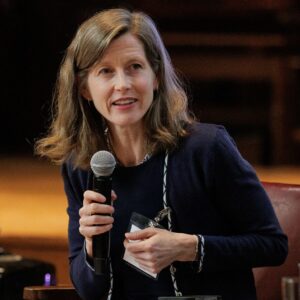
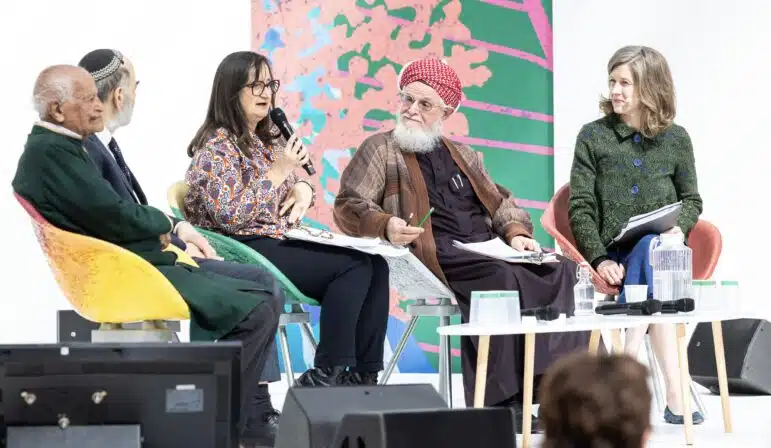
CEE Executive Director Karenna Gore delivered the following remarks in Paris at the 2026 ChangeNOW Summit, a “global meeting point for those building a just and sustainable future.” After her keynote address, she moderated an interfaith panel featuring Satish Kumar, Rabbi Jonathan Wittenberg, Othman Llewellyn and Laura Morosini. Together, they explored environmental and social transformation through the lens of religion, spirituality and ethics.
It is a pleasure to be back in this beautiful city for many reasons, including that “Paris” has become synonymous with an ideal that was embodied here in 2015—in the international commitment to impose limits on our societies infringement on the boundaries of the Earth. That convergence affected me deeply.
In fact, I was here then, during COP21, and I will never forget the feeling. It felt like we had finally turned a corner, with the nations of the Earth acknowledging the problem—and their responsibility for fixing the problem.
How long ago that seems.
It was a moment of realism as much as idealism, What is most real is air, water, soil, sunshine, wind—the elements in our bones and blood that we share with the Earth. We are the same substance, with matter and spirit together.
2015 also marked a turning point in my life that included the founding of the Center for Earth Ethics at Union Theological Seminary, where my work is based.
Since then, we have learned more, and have advanced in technologies and capacities. We have also learned that the climate crisis is about more than data, science and technology, as important as they are. It is about our perception and our values.
The intelligence of our species is on trial. If we are to prevail—to stop the destruction of our own habitat and to begin caring for it instead—it will be because we draw from another form of intelligence than the one we have been relying on to build and maintain these systems that dominate now.
We need emotional intelligence in addition to our rational intelligence. We need qualitative intelligence in addition to our quantitative intelligence. We need the holistic intelligence to know that we are not, in fact, all that intelligent—not as long as we measure success by conventional economic metrics like salaries or stocks or GDP.
We not only need information, we need wisdom. We not only need progress, we need balance. We not only need to have faith in something greater than ourselves, we need to have faith in who we are as human beings, including our belonging with and to the Earth.
Faith has been called “the substance of things hoped for, the evidence of things not seen.” That is in the New Testament, which I was raised on in Baptist Church. It is one example of the kinds of teachings that lie in faith traditions that are more philosophical or mystical than doctrinaire. In this session, we will learn key teachings from diverse faith and wisdom traditions and how they connect to our ability to make systemic change now—and co-create an age of thriving together with the rest of nature.
First let me say that one of the issues that comes up with faiths is that many people associate them with the dogmatic, divisive and hypocritical parts of religion. And so yes, part of the change needed is for religions to correct their own errors—or continue to do so, in some cases. We are going to stay positive here but I will mention two such errors: 1) too often and for too long the major world religions have demeaned, diminished and disrespected the feminine and the female, even while so many women and girls do generous work to uphold them, not to mention giving and upholding life itself; (2) too often and for too long, religions have located the sacred in a realm far away from the Earth, even as the body of the Earth gives us life and beauty and reflects a creator divinity that those traditions profess to embrace. These two mistakes are related, which makes their correction all the more powerful. The life-giving nature of the Earth and of the feminine are infused with spiritual energy and high intelligence, and are fully deserving of reverence and inclusion.
Seeing beyond the errors that are ripe for correction, let us also acknowledge that at their best, the worlds faith and wisdom traditions have long been sites for good, including for discerning and holding fast to values that are deeper than politics or price tags—values that stand the test of time. This means helping people find (or remember) meaning and purpose in life, nurturing rich cultural traditions that include spaces to make music and share food and greet each others and families in multigenerational togetherness. It means providing spiritual support to people amidst the strains inherent in every human life, and especially in times of major conflict and turmoil. It means seeing children, the elderly and the marginalized in a world that increasingly trains us to ignore—or even blame—those in need.
As Rabbi Jonathan Wittenberg wrote in a recent blog post, “We must not let our heart be shrunk, our soul extinguished, our compassion exhausted, or our eyes be blinded to beauty and blessing.”
The most fundamental change we need is a change of perception: how we perceive where and who we are. The Earth is not an inert set of resources for our economies. It is an interconnected whole with elements, energies and living beings—of which human beings are one kind.
Across the world, many faith communities also have holdings in land and buildings and provide services as basic as schooling and health care—and even in the parts of the world that are increasingly secular, they attend to the rituals of the most important turning points in many peoples personal lives. All of this means that they hold great power to make precisely the kind of collective change we need. And so today we call for support those that are working for the epic ecological turn in these traditions and institutions—towards full commitment to the Earth, for the long term well-being of the whole community of life which is the common good.
It is what Pope Francis so wisely wrote about as “ecological conversion” in his encyclical Laudato Si. This ecological turn includes care for those most impacted by climate change, including the huge number of migrants projected as well as the most vulnerable people within our own communities. It also means preventing this from getting worse—by protecting waterways and forests, by switching from fossil fuels to renewable energies—and by speaking the truth.
The most fundamental change we need is a change of perception: how we perceive where and who we are. The Earth is not an inert set of resources for our economies. It is an interconnected whole with elements, energies and living beings—of which human beings are one kind. As Thomas Berry said, it is a “communion of subjects not a collection of objects.”
We are fully dependent on the life-support system of this planet, which is itself alive. The notion that we will invent a mechanical one to replace it is as grim as it is unrealistic. So instead, let’s draw on our faith and wisdom traditions to recognize that nature has agency, animacy and life force. As the Rights of Nature movement argues, this means natural entities like forests should have legal standing—no longer treated merely as inanimate, disposable property.
As Al-Mizan calls for (the lead author Othman Llewellyn is with us here), the world should officially recognize that ecocide is a crime. Let us at least make sure that we collectively come to an understanding that other living beings—those that fly in the sky, swim under water, and walk and crawl the land and are more our relatives than these robots and artificial chatbots are. As the Haudenosaunee (also known as the Iroquois) say in A Basic Call to Consciousness, “it is the natural world and the traditions of the natural world that must prevail if we are to have truly free and egalitarian societies.”
Indigenous traditions teach us many things, and one of the most powerful is that if we wish to survive and thrive, we must decolonize—and if we wish to decolonize, we must bring serious engagement with the spiritual dimensions of the natural world back into our decision-making. It is here that science and faith meet. I will mention three metaphysical categories which we can bring back into full awareness: time, place and being.
Time: we must widen our circle of moral concern to include future generations and our ancestors.
Place: we can re-associate and connect with our local ecosystems. This includes uplifting biocultural heritage, including traditional ecological knowledge.
Being: we must recognize that life is interconnected and continuous, that we are in a web of being with other species and elements. As Satish Kumar has said and demonstrated “when we practice humility and gratitude we are able to learn much”—not ‘about’ nature but from nature, and that includes that we are nature.
Alongside this change in perception we need an ongoing rigorous commitment to seeing our ecological circumstances through the discipline of ethics. It is not the Earth that needs fixing, it is us. This is why those working around the United Nations COP process should support the Global Ethical Stocktake, an innovation of the UN COP30 Presidency of Brazil that can continue and deepen and grow.
Ethics undergirds laws and social norms but is most powerful when a deeply felt sense of right and wrong is out of step with both laws and social norms. That is when we must draw from deeper wells of human values. Today this is where we are with regard to the human relationship to the Earth. Most of what is causing ecological destruction is perfectly legal and even socially encouraged. Now, we will hear from the sages on our topic: faith and wisdom for the Earth. I am now honored to sit down with Rabbi Jonathan Wittenberg, Satish Kumar, Laura Morosini and Othman Llewellyn.