
New York Weighs Moratorium on New Data Centers
Artificial Intelligence (AI) is rapidly transforming society, influencing everything from governance, business and education, to personal interactions and decision-making. There are now more than one billion people around the world using standalone AI platforms each month. OpenAI’s ChatGPT is used by at least 700 million people monthly—more than 10% of the world’s adult population.
Even those who avoid AI platforms like ChatGPT still use AI in ways they may be unaware of. In the US, 36% of Americans report regularly using AI. But nearly all Americans use products that involve AI, though nearly two-thirds (64%) don’t realize it. When asked about their usage of common AI-enabled products—including personal virtual assistants, navigation apps, weather forecasting apps or websites, social media platforms, streaming services and online shopping—99% of U.S. adults reported using at least one of these in the past week.
Data and AI models are stored in the “cloud,” which is often imagined as a virtual space, working away mysteriously in the ether. The tech and AI industry has long benefited from the assumption that the digital world is wireless. Spoiler: it’s not.
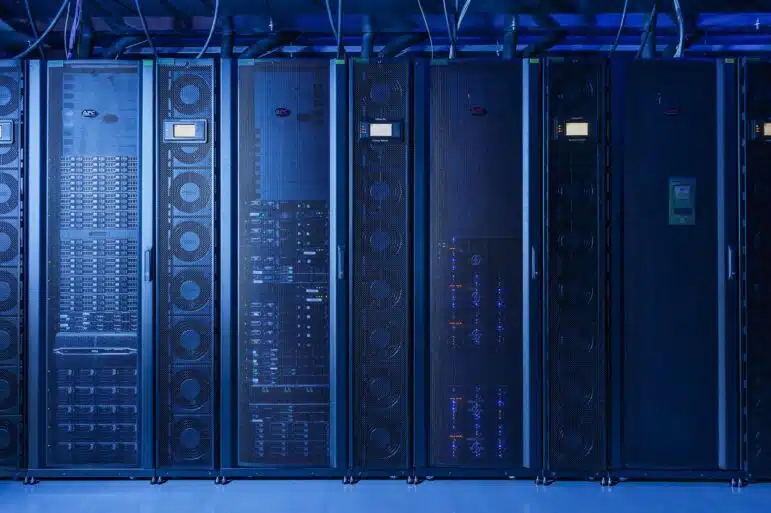
What most AI-users forget is that the “cloud is not virtual, it is physical.” Storing data or running applications and AI programs in the cloud requires servers located in real, physical spaces—data centers—which require extensive infrastructure and resources to build and operate. They need huge volumes of fresh water for cooling, electricity, metals, microchips and fiber-optic cables. The recent surge in AI use, paired with a federal government that is actively loosening the regulatory guardrails around data center permitting, introduces massive new questions on how to manage the energy, water and waste externalities associated with AI. With every search query, AI-generated image and streamed video that pass through data centers, these questions only deepen.
The costs are now under scrutiny in New York. On February 6, 2026, State Senators Liz Krueger and Kristen Gonzalez introduced Senate Bill S9144, which would impose a three-year moratorium on new data center permits, on the grounds that their growth is inconsistent with the state’s climate commitments. New York is the sixth state to introduce such legislation in recent months, part of a growing and surprisingly bipartisan backlash in statehouses across the country. To understand why, it helps to follow the money, and the emissions.
The Cost of the Cloud
A single data center consumes as much water as a city of 50,000 people. Scaled up nationally, AI-supporting data centers could consume 720 billion gallons of water and 300 terawatt-hours (TWh) of electricity annually by 2028—enough water to fill more than one million Olympic-size swimming pools and enough electricity to power more than 28 million American households.

These demands do not stay abstract for long—the costs flow directly to ordinary ratepayers. Across the country, energy bills for households and small businesses have increased in areas experiencing rapid data center buildout. Electricity costs near significant data center activity rose by 267% in just five years. Despite industry assurances, companies in Georgia and Ohio have resisted measures that would prevent costs from being passed on to ratepayers.
These energy demands have direct environmental and public health consequences. A Cornell University analysis found that data center expansion could add as much as 44 million metric tons of carbon dioxide to the atmosphere by 2030, equivalent to the annual emissions of approximately 10 million passenger cars. Air pollution from data centers alone could cause an additional 600,000 asthma cases and an estimated 1,300 premature deaths every year.
Not everyone absorbs these costs equally. Research consistently shows that data centers and the power plants built to supply them cluster in communities already bearing disproportionate environmental burdens.
Moreover, not everyone absorbs these costs equally. Research consistently shows that data centers and the power plants built to supply them cluster in communities already bearing disproportionate environmental burdens—places with polluted air, threatened groundwater and little political leverage to push back. Nearly half of the roughly 700 data centers examined in one national review were located in census tracts flagged by the CDC’s Environmental Justice Index for above-median exposure to pollution and social vulnerability. The infrastructure of AI, it turns out, follows a very old pattern of injustice.
Meanwhile, data centers are among the most heavily subsidized industries in the U.S. Though the industry promises to bring economic growth, States lose billions of dollars annually through tax exemptions and other incentives. According to Good Jobs First, at least ten states lose more than $100 million annually in tax revenue to data centers, with Texas losing more than $1 billion in 2025 and Virginia over $700 million in 2024. Some states have calculated their return on investment and determined that they lose between 52 and 70 cents for every dollar spent on data center sales tax exemptions. For all these subsidies, a single facility operates with only a few dozen employees—data centers create 100 times fewer jobs per unit of electricity consumed than other industries.

New York's Grid
New York already has more than 130 data centers statewide, with nearly half located in the New York City metropolitan area. As of January 2026, the New York Independent System Operator (NYISO) interconnection queue included 48 new large-load projects totaling more than 11 gigawatts of demand. Of the 25 new projects added to the queue this year, over half are data centers. Together, they are projected to add more than 7,000 megawatts of electricity usage by 2030—enough to power seven million homes. This comes as NYISO’s latest report already projects that, even without additional data center development, New York faces the prospect of an energy emergency within the next decade.
That surge in demand requires more fuel, and early promises that data centers would run on renewable energy have largely not held up. Across the country, states are keeping coal plants open, building new gas-fired power plants, and reopening nuclear facilities to keep pace.
New York’s grid is already buckling under the pressure. The approval of the North East Supply Enhancement (NESE) pipeline on November 28, 2025—designed to transport more than 400,000 dekatherms of fracked gas from Pennsylvania into the state—made that clear. As Alli Finn of the AI Now Institute said: “It is no secret that expanding gas infrastructure is directly tied to the data center build-out. And that is because these facilities just use an exponential amount of energy.”
NESE is a direct consequence of that dynamic. The pipeline would increase New York’s greenhouse gas emissions by 12%, severely undermining the state’s goal of achieving 100% zero-emission electricity by 2040. A last-ditch effort by the Natural Resources Defense Council for a rehearing was dismissed on December 22, and the pipeline is on track for a 2027 completion.
The approval process raised its own concerns. The streamlined NESE permitting skipped required public hearings and shortened the window for public comment, despite more than 10,000 submissions in protest, including objections from 137 public officials. It was a preview of what unregulated data center expansion looks like in practice: demand moves fast, public input gets compressed, and the infrastructure gets built.
It was a preview of what unregulated data center expansion looks like in practice: demand moves fast, public input gets compressed, and the infrastructure gets built.
The Proposed Moratorium
Senate Bill S9144 would pause new data center permits for three years, covering construction, siting, and commencement of operations. Proponents frame it as a responsible pause: stop, assess what is happening in other states, establish clear rules, and lift the ban once adequate regulations are in place. The bill would give New York policymakers time to evaluate whether current subsidy structures, interconnection processes, and fossil fuel dependencies are consistent with the Climate Leadership and Community Protection Act (CLCPA), which requires the state to reach net-zero by 2040.
The political path is uncertain. Governor Kathy Hochul has recently announced that the New York State Public Service Commission will review interconnection processes and cost-allocation mechanisms for large-load customers, with the goal of ensuring data center companies cover the costs of their grid expansion rather than burdening ratepayers. It is a meaningful step, but one that stops well short of the structural pause legislators and environmental groups are demanding.
Adding to this complexity, the Trump administration’s AI Action Plan calls for expediting data center permits and rolling back the environmental and land-use regulations it considers obstacles to economic growth. It warrants the question: can a state stall data center development under a federal government looking to expand it? And if not in New York, then where will the data centers be sited?

What Comes Next?
What is playing out in New York reflects a national reckoning with the true costs of AI infrastructure. In early December 2025, more than 230 national, state and local organizations wrote a letter to Congress calling for a national moratorium, describing the expansion as “one of the biggest environmental and social threats of our generation.” Data centers encroach on wilderness areas, state parks and historic sites. In some cases, their construction has damaged century-old Black cemeteries and threatened Indigenous communities‘ land, water and sovereignty. The federal government has recently opened up federal lands to data center construction, over the objections of Tribal Nations.
The moratorium’s supporters are trying to interrupt a familiar pattern. Developers arrive with promises of jobs and economic growth, and then, when the jobs don’t materialize but the grid strain does, those communities find themselves embroiled in years of legal and regulatory battles, while companies rake in huge profits.
There is a version of this story where New York gets it right: where the moratorium passes, the regulations catch up, and the state figures out how to host the infrastructure the digital economy demands without abandoning the commitments it has made to its people. It has done it before, when it placed a moratorium on energy-consuming cryptomining facilities. Is it prepared to do it again?