Karenna Gore Joins Columbia Climate School Panel on COP30 Reflections
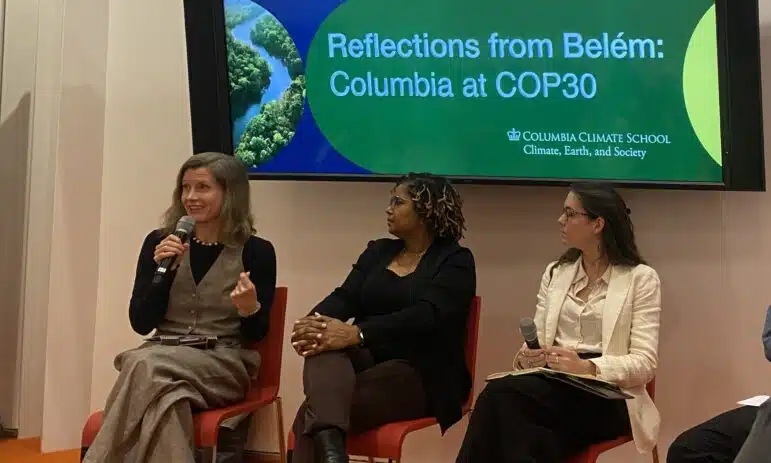
On Monday, December 1, 2025, Center for Earth Ethics Executive Director Karenna Gore joined “Reflections from Belém: Columbia at COP30” for a conversation discussing takeaways from COP30. The panel, moderated by Director of the National Center for Disaster Preparedness and Columbia Climate School Professor Jeffrey Schlegelmilch, reflected on negotiation outcomes, civil society participation, and what comes next.
Gore discussed her work on the Global Ethical Stocktake, describing the importance of integrating ethics, alongside science and technology, into multilateral climate policy, saying, “it’s about human perception and behavior.” Responding to widespread dissociation and dissonance, she also called on those in the U.S. to have “an honest conversation about the costs of our extractive economy.”
Finally, Gore shone a spotlight on the influx of fossil fuel industry lobbyists at UN climate summits—and the ways in which this skews climate negotiations. She underscored that “it isn’t a mystery” what is driving climate disasters and denial, quoting Ida B. Wells: “the way to right wrongs is to turn the light of truth upon them.” She also noted how the effects of disinformation campaigns levied by the fossil fuel industry go beyond the misleading content itself, becoming visible in what is not said. Specifically, she pointed to societal apathy and silence around directly addressing fossil fuel use in high-level discussions of climate solutions, skewing the public conversation away from the root cause of climate change while fossil fuel companies make record profits.
Columbia Climate School Professor Sheila Foster focused on participation and inclusion. She observed the enduring skepticism from countries experiencing climate devastation, since “all of the finance is still aspirational with respect to the communities and the parts of the world that are hit hardest.” Foster explained that ambition is driven by “the lowest common denominator” under the UN’s current consensus-based process. This must be addressed if we hope to close this gap between the promises made and the material resources provided, she said. She also underscored that “nation-states will only behave in ways that we allow them to,” calling on the audience not to over-rely on top-down action.
Amy Campbell, a former UK climate negotiator, Columbia Climate School alumna and member of the UN Secretary-General’s Climate Action Team, explained the significance of the agreement to triple adaptation finance by 2035 and the 59 indicators agreed in the Global Goal on Adaptation. She acknowledged the impressive mobilization of political will, as well as the remaining ambiguity around this goal. When reflecting on the COP process, Campbell emphasized that we must distill “what COP is and isn’t for.” She remarked on the sheer feat of bringing 197 countries together and the importance of working in between sessions to catalyze action.
Thank you to Columbia Climate School for convening this conversation as we carry climate action forward beyond COP30.